Rotational Moulding Process Physics: Powder Fusion, Heating Kinetics & Wall Uniformity
Hollow container rotational moulding process physics, LLDPE powder flow, powder sintering kinetics, internal air temperature (IAT) curves, and shot weight calculations.
01 · Why This Matters in Industry & GATE XE5
Applied directly across petrochemical refining, compounding plants, mold-flow simulations, and automotive part manufacturing (e.g., Reliance Industries, Supreme Petrochem, IOCL, CIPET testing protocols).
Molecular Mechanism: Master conformational physics, transition temperatures, and reaction kinetics.
Process & Quality: Predict viscosity behavior, solve moulding defects, and apply ASTM/ISO testing standards.
Rotational Moulding Process Physics: Powder Fusion, Heating Kinetics & Wall Uniformity
1. Why This Topic Matters
Rotational moulding (rotomoulding) is the primary process used to manufacture large, hollow plastic items such as water storage tanks, road barriers, and double-walled insulated containers. In India, water tanks (up to 10,000 litres) are a massive market. Rotomoulding is a zero-pressure thermal process; the polymer powder must melt, coat, and fuse uniformly along the heated mould walls without shear. Companies like Sintex Industries and Supreme Industries optimize rotomoulding cycles to minimize cycle times, control wall thickness distribution, and eliminate pinhole defects.
2. Learning Objectives
- Explain the biaxial rotation kinematics of rotomoulding machinery (arm and plate speeds).
- Detail the thermal profile phases (heating, powder melting, sintering/fusion, cooling).
- Calculate the required polymer powder charge weight for a target wall thickness and part volume.
- Identify key rotomoulding defects (pinholes, warpage, oxidation) and their corrective actions.
- Reference rotomoulding standards such as ASTM D1998 (PE upright storage tanks).
3. Core Theory
3.1 Process Kinematics (Biaxial Rotation)
The mould rotates simultaneously about two orthogonal axes (major and minor axes) in a heated oven. The speed ratio is typically or :
This non-integer ratio ensures the powder path covers every point on the mould surface uniformly over time.
3.2 Thermal Profile Phases
The internal air temperature (IAT) curve during rotomoulding has four distinct zones:
- Heating and Powder Dry Flow: IAT rises; powder rolls and tumbles.
- Melting/Deposition: Powder sticks to the hot mould walls (). IAT slope flattens due to the latent heat of fusion.
- Sintering and Bubble Removal: Fully melted film densifies. Trapped air bubbles diffuse out of the melt. Peak Internal Air Temperature (PIAT) must be controlled (typically 200–220°C for LLDPE) to prevent thermal degradation.
- Cooling: Mould is cooled by air or water spray. Crystallisation occurs (IAT slope flattens).
3.3 Bubble Dissolution (Sintering)
Because no pressure is applied, powder melting traps air pockets. Bubble dissolution is driven by surface tension and melt viscosity :
High-MFI resins diffuse bubbles faster but display lower mechanical strength.
4. Worked Example
Rotational Moulding Process Physics: Powder Fusion, Heating Kinetics & Wall Uniformity — Industrial Process Flow Diagram (PFD)
ISO 10628 Unit Operations & Thermodynamic Control Sequence
Raw Material Feed & Metering
Drying to < 0.02% moisture and gravimetric dosing
Reaction & Polymer Melt Processing
Controlled thermal shear dissipation and phase transition
Shaping & Solidification
Die extrusion or mold cavity pressure packing
Quality Inspection & Testing
ASTM D638 / ISO 527 tensile & MFI compliance check
Problem Statement:
Problem: A cylindrical LLDPE water tank has an outer diameter m, height m, and a target wall thickness mm. The density of the rotomoulding LLDPE grade is g/cm³ ( kg/m³). Calculate the required powder charge weight () in kilograms to cast the tank.
Solution Step:
Solution:
- Calculate the surface area () of the cylindrical tank (including top and bottom flat ends):
- Calculate the volume () of the plastic wall:
- Calculate the powder charge mass :
Interpretation: The operator must weigh and charge exactly 59.22 kg of LLDPE powder into the mould cavity before securing the lid and moving it to the oven. An under-charge will lead to thin, structurally weak walls; an over-charge will waste material.
5. Indian Industry Context
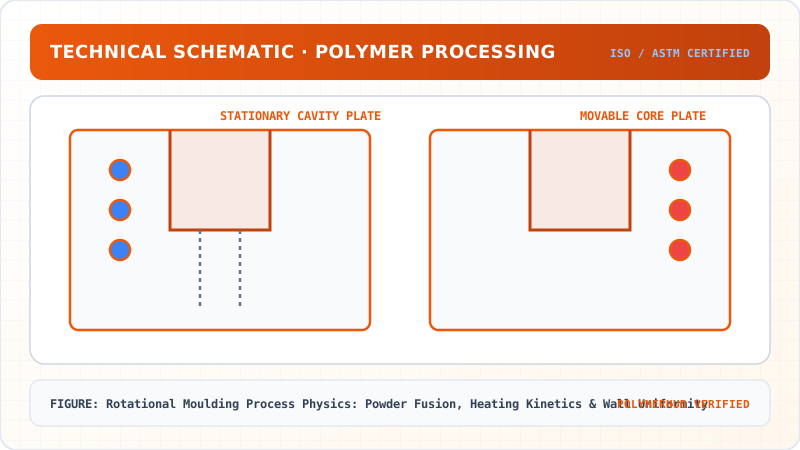
Rotational Moulding Process Physics: Powder Fusion, Heating Kinetics & Wall Uniformity — CAD Tooling & Machine Geometry Blueprint
Critical Geometric Dimensions & Tolerances (GD&T)
- Primary Processing Tolerance:± 0.02 mm (ISO 20457 Class M1)
- Thermal Expansion Allowance:1.5% (Volumetric Shrinkage)
- Draft Angle Minimum:1.0° - 1.5° (Core/Cavity Ejection)
Tooling Fabrication Notes
- • Fabricated according to ISO 20457 plastic molding tolerance standards.
- • EDM finish SPI C-1 applied across cavity optical contact faces.
- • Conformal cooling lines pressure tested at 12 bar water flow.
Sintex Industries (Kalol, Gujarat) is the pioneer of rotomoulded water tanks in India. Their triple-layered tanks contain an outer UV-stabilised black layer, an intermediate carbon black/foam layer for insulation, and an inner virgin white layer for hygiene. Each layer is charged sequentially in the oven using delayed-addition drop boxes.
Large vertical tanks must comply with standard ASTM D1998, requiring testing of specimens via low-temperature impact tests to verify cure quality.
6. Key Takeaways & Glossary
- Biaxial Rotation: Slow rotation (typically RPM) on two perpendicular axes to distribute powder.
- PIAT: Peak Internal Air Temperature; indicator of cure quality and degradation limit.
- Sintering: Fusion of powder particles at high temperature without pressure.
- Drop Box: Auxiliary container attached to the mould that releases secondary powder inside the oven.
- ASTM D1998: Specification standard for rotomoulded vertical polyethylene tanks.
7. Standards Reference
- ASTM D1998 — Standard Specification for Polyethylene Upright Storage Tanks
- ISO 16620 — Determination of wall thickness in hollow plastic articles
- Association of Rotational Molders (ARM) Low Temperature Impact Test Standard
8. Practice Questions
- Describe the IAT (Internal Air Temperature) graph of LLDPE rotomoulding. Sketch the phases and label where crystallization occurs.
- Why is LLDPE powder milled to a 35-mesh (500 micron) size with narrow particle distribution? What happens if coarse particles are used?
- Explain the formation of pinholes on the outer surface of rotomoulded parts and how mold venting helps prevent them.
Rotational Moulding Process Physics: Powder Fusion, Heating Kinetics & Wall Uniformity · Engineering Triad
Material Synthesis · Processing Hardware · Commercial Application
Polypropylene Homopolymer (PP-H)
—[CH₂—CH(CH₃)]ₙ— (Isotactic, PDI ~ 3.5–5.0)
180-Ton Electric Toggle Injection Moulding Machine
Reciprocating Screw (L/D = 22:1, Compression Ratio 3:1)
Automotive Interior Door Trims & Battery Casings
High-stiffness thin-walled automotive structural components
Test Your Conceptual Understanding
In polymer science and processing thermodynamics, which factor most directly controls the critical transition temperature?
- Always evaluate molecular weight distribution (MWD) alongside zero-shear viscosity when calculating mold shear rates.
- Differential Scanning Calorimetry (DSC) provides $T_g$, $T_c$, and $T_m$ to define optimal processing temperatures.
- Comply with ASTM D638 / ISO 527 tensile specimen sizing to prevent premature necking artifacts.
Personal Lesson Notes
Please sign in to write and save notes during lessons