Micro-Injection Molding — Process & Applications
Process mechanics of micro-injection molding, micro-features replication, tooling accuracy, variothermal heating, and applications in medical devices.
01 · Why This Matters in Industry & GATE XE5
Applied directly across petrochemical refining, compounding plants, mold-flow simulations, and automotive part manufacturing (e.g., Reliance Industries, Supreme Petrochem, IOCL, CIPET testing protocols).
Molecular Mechanism: Master conformational physics, transition temperatures, and reaction kinetics.
Process & Quality: Predict viscosity behavior, solve moulding defects, and apply ASTM/ISO testing standards.
Micro-Injection Molding — Process & Applications
1. Why This Topic Matters
In an era of relentless miniaturization and increasing demand for high-performance, compact components, Micro-Injection Molding (MIM) has emerged as a critical manufacturing technology. For aspiring polymer engineers, understanding MIM is not merely an academic exercise but a gateway to innovation across diverse high-tech sectors.
Real-World Relevance: From life-saving medical implants and sophisticated diagnostic kits to miniaturized electronics, automotive sensors, and advanced micro-optics, MIM enables the mass production of intricate plastic parts with dimensions often below 100 micrometers. This technology is foundational for smart devices, personalized healthcare, and next-generation mobility solutions.
Career Relevance: The burgeoning fields of biomedical engineering, microfluidics, advanced materials, and precision manufacturing are actively seeking engineers proficient in micro-fabrication techniques. Expertise in MIM offers unique career opportunities in R&D, process development, quality assurance, and design engineering for global technology leaders and specialized manufacturing firms. It positions graduates at the forefront of engineering challenges involving extreme precision, material science, and process optimization.
Specific Engineering Significance: MIM presents profound engineering challenges and solutions that push the boundaries of polymer science and processing. It involves critical considerations such as:
- Precision Tooling: Fabrication of molds with micro-scale features demands advanced micromachining techniques and ultra-high accuracy.
- Material Behavior at Micro-Scale: Polymer melt flow in micro-cavities exhibits complex phenomena like increased shear rates, wall slip effects, and significant surface tension, altering conventional flow assumptions.
- Process Control: Achieving consistent replication of micro-features requires exceptionally tight control over injection parameters, mold temperature, and cooling rates, often necessitating advanced techniques like variothermal molding.
- Quality Assurance: Metrology for micro-components requires sophisticated optical and tactile measurement systems to ensure dimensional accuracy and surface quality. These unique aspects underscore MIM's significance as a specialized yet indispensable polymer processing technique.
2. Learning Objectives
Upon successful completion of this lesson, students will be able to:
- Differentiate and explain the fundamental process variations and unique challenges of micro-injection molding compared to conventional injection molding, particularly concerning polymer melt flow and feature replication.
- Analyze and correlate the impact of critical process parameters, tooling design, and material selection on the quality and dimensional accuracy of micro-injection molded components, including the role of variothermal molding.
- Evaluate and propose suitable applications for micro-injection molded polymeric components, with a specific focus on the stringent requirements and growing demands within the medical device industry.
3. Core Theory & Mathematical Principles
Micro-injection molding (MIM) is a specialized subset of injection molding designed to produce polymer parts with features or overall dimensions in the micrometer range. While the basic principles of injection molding apply, MIM introduces significant complexities due to scale effects.
Process Mechanics: The typical MIM machine features a reduced shot size capacity, achieved through smaller screw diameters (e.g., 8-14 mm) or specialized plunger-piston systems, ensuring precise dosing for micro-parts.
- Melt Flow in Micro-Channels: When polymer melt flows into micro-cavities, the surface-to-volume ratio increases dramatically. This leads to:
- High Shear Rates: Due to small clearances, shear rates can reach . Polymers exhibit highly non-Newtonian, shear-thinning behavior at these rates.
- Fountain Flow: The advancing melt front exhibits fountain flow, where material at the center moves faster than at the walls, folding back on itself. In micro-channels, this effect is pronounced, influencing molecular orientation and mechanical properties.
- Wall Slip: The interaction between the polymer melt and the mold wall becomes significant. Polymer chains near the wall can experience slip, especially for specific material-mold surface combinations, which can affect filling behavior and surface finish.
- Surface Tension: Capillary effects become dominant. The surface tension of the molten polymer can hinder complete filling of very fine features, particularly for high aspect ratio structures, leading to incomplete replication or air entrapment.
- Cooling Rates: Micro-parts have very high surface-to-volume ratios, leading to extremely rapid cooling. This rapid cooling often results in:
- High Residual Stresses: Differential cooling across the part thickness generates internal stresses, potentially leading to warpage or reduced mechanical strength.
- Crystallization Behavior: For semi-crystalline polymers, rapid cooling can lead to smaller crystallite sizes or amorphous regions, impacting mechanical and optical properties.
- Pressure Requirements: Despite small part volumes, the high flow resistance in micro-channels, often due to thin walls and small gates, necessitates higher injection pressures compared to conventional molding.
Micro-Feature Replication: Replication fidelity is paramount in MIM. Key factors include:
- Viscosity: Low melt viscosity is desired for good flowability into fine features.
- Mold Wettability: The contact angle between the melt and the mold surface influences filling. Good wettability (low contact angle) is preferred.
- Aspect Ratio: Features with high aspect ratios (height/width) are challenging to fill completely without defects (e.g., short shots, trapped air). Vacuum venting systems are often employed.
Tooling Accuracy: The mold cavity dictates the final part geometry. Precision micromachining techniques are crucial for mold fabrication:
- LIGA Process: (Lithographie, Galvanoformung, Abformung - Lithography, Electroplating, and Molding) allows for the creation of high aspect ratio metal microstructures, which can then be used as mold inserts.
- Micro-Electro-Discharge Machining (μ-EDM): Precise removal of material using electrical discharges, suitable for complex geometries and hard materials.
- Laser Ablation: Using focused laser beams to remove material, offering high precision and flexibility.
- Micro-Milling: Mechanical removal of material with very small cutters. Mold inserts often feature surface roughness values () below to ensure smooth part surfaces and easy demolding.
Variothermal Heating (Dynamic Mold Temperature Control): This advanced technique is a cornerstone of high-fidelity MIM. It involves rapidly heating the mold cavity during the filling phase and then quickly cooling it during the holding/cooling phase.
- Principle:
- Heating Phase: Before/during injection, the mold surface is heated above the polymer's glass transition temperature () or melting temperature (). This reduces melt viscosity, improves flowability, and allows for complete filling of micro-features. It also reduces freeze-off at the gate.
- Cooling Phase: After the cavity is filled and packed, the mold is rapidly cooled to solidify the part, minimizing cycle time.
- Benefits:
- Improved replication fidelity, especially for high aspect ratio features.
- Reduced residual stresses and warpage due to more uniform cooling.
- Enhanced surface quality (gloss, reduced weld lines).
- Potential for reduced cycle times (though complex control can add overhead).
- Methods: Common methods include induction heating, electrical cartridge heaters, pressurized hot water/oil, steam heating, or infrared lamps.
Mathematical Principles:
- Shear Rate in a Rectangular Micro-Channel: For a power-law fluid flowing between two parallel plates (approximation for thin channel):
where $Q$ is the volumetric flow rate, $B$ is the channel width, and $H$ is the channel height.
2. Apparent Viscosity for Power-Law Fluid:
where $K$ is the consistency index and $n$ is the power-law index.
3. Pressure Drop in a Rectangular Channel (for a power-law fluid): For laminar flow, the pressure drop can be estimated as:
This is an approximation and more complex models or FEM simulations are often used for precision.
4. Volumetric Shrinkage: The primary driver for part shrinkage is the density change from melt to solid state.
where $\rho_{solid}$ is the density of the solidified polymer and $\rho_{melt}$ is the density of the polymer melt at injection temperature.
5. Heat Transfer (Fourier's Law): Cooling rate in the mold is governed by heat conduction.
where $q$ is heat flow, $k$ is thermal conductivity, $A$ is area, and $dT/dx$ is temperature gradient. For transient cooling of a thin part, the time required to cool below solidification temperature is critical.
4. Worked Numerical Example
Micro-Injection Molding — Process & Applications — Industrial Process Flow Diagram (PFD)
ISO 10628 Unit Operations & Thermodynamic Control Sequence
Raw Material Feed & Metering
Drying to < 0.02% moisture and gravimetric dosing
Reaction & Polymer Melt Processing
Controlled thermal shear dissipation and phase transition
Shaping & Solidification
Die extrusion or mold cavity pressure packing
Quality Inspection & Testing
ASTM D638 / ISO 527 tensile & MFI compliance check
Problem Statement:
Problem: A micro-fluidic chip component with a rectangular micro-channel needs to be molded using Polypropylene (PP). The channel dimensions are , , and . The desired filling time for this channel segment is . Estimate the average shear rate and the approximate pressure drop required to fill this channel, assuming PP behaves as a power-law fluid with and at the molding temperature.
Initial Conditions & Variables:
- Channel Length ():
- Channel Width ():
- Channel Height ():
- Filling Time ():
- Power-law consistency index ():
- Power-law index ():
Step-by-Step Calculation:
1. Calculate the Volume of the Micro-Channel:
2. Calculate the Volumetric Flow Rate ():
3. Calculate the Average Shear Rate (): Using the formula for average shear rate in a rectangular channel:
4. Calculate the Pressure Drop (): Using the approximate formula for pressure drop for a power-law fluid in a rectangular channel:
First, calculate the term :
Now substitute values into the equation:
Calculate Calculate
Result Interpretation: The calculated pressure drop of approximately is extremely high and indicates that such small channels are incredibly difficult to fill. This illustrates the immense challenges in MIM, where traditional pressure requirements (typically up to ) are orders of magnitude lower. This highlights the necessity for:
- Materials with significantly lower values (less viscous).
- Higher melt temperatures to further reduce viscosity.
- Optimization of channel geometry to minimize flow resistance.
- Advanced processing techniques like variothermal molding to effectively reduce resistance during critical filling phases.
Note: This calculation uses an approximate analytical solution. Real-world scenarios would utilize sophisticated CAE software (e.g., Moldflow, Autodesk Fusion 360, Simufact) for more accurate and comprehensive mold filling simulations considering complex geometries, thermal effects, and non-isothermal flow.
5. Indian Industrial Context
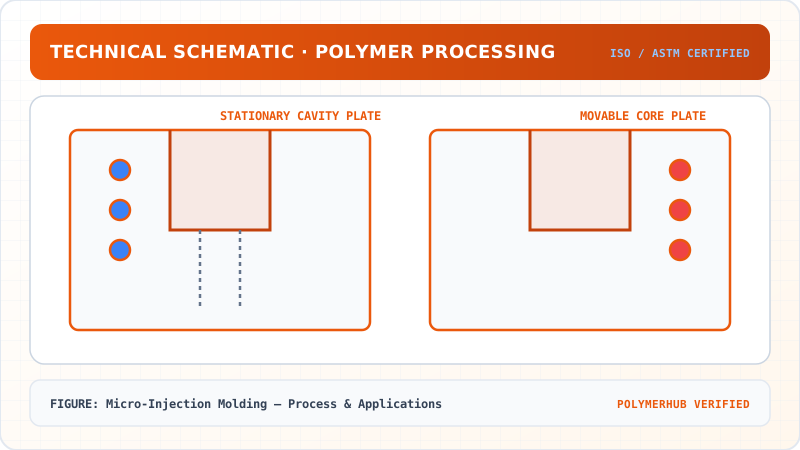
Micro-Injection Molding — Process & Applications — CAD Tooling & Machine Geometry Blueprint
Critical Geometric Dimensions & Tolerances (GD&T)
- Primary Processing Tolerance:± 0.02 mm (ISO 20457 Class M1)
- Thermal Expansion Allowance:1.5% (Volumetric Shrinkage)
- Draft Angle Minimum:1.0° - 1.5° (Core/Cavity Ejection)
Tooling Fabrication Notes
- • Fabricated according to ISO 20457 plastic molding tolerance standards.
- • EDM finish SPI C-1 applied across cavity optical contact faces.
- • Conformal cooling lines pressure tested at 12 bar water flow.
India's manufacturing sector is witnessing a growing emphasis on precision engineering, driven by initiatives like "Make in India" and "Atmanirbhar Bharat." Micro-injection molding, while still in its nascent stages compared to global leaders, is gaining traction, particularly in sectors requiring high-precision polymer components.
- Medical Device Manufacturing: This is a rapidly expanding sector in India, with increasing demand for indigenous production of critical components. Companies are focusing on producing high-volume, low-cost medical devices like diagnostic kits, microfluidic chips, surgical instruments with micro-features, drug delivery systems, and miniaturized components for monitoring devices. MIM is crucial for achieving the required precision, biocompatibility, and sterilization compatibility. Organizations like Hindustan Latex Limited (HLL Lifecare), Trivitron Healthcare, and several MSMEs in medical device clusters are exploring or adopting MIM technologies.
- Electronics and Automotive: The growth of smart electronics, IoT devices, and electric vehicles (EVs) in India creates demand for miniature connectors, sensor housings, micro-switches, and aesthetic components. Indian automotive component manufacturers, under pressure to meet global standards and local EV demands, are looking into MIM for precision parts.
- Research & Development: Premier academic and research institutions like the Indian Institutes of Technology (IITs), National Institutes of Technology (NITs), and the Council of Scientific and Industrial Research (CSIR) labs are actively engaged in micro-fabrication research, including polymer micro-molding. They are working on developing indigenous capabilities, novel materials, and process optimization strategies for MIM.
- CIPET (Central Institute of Petrochemicals Engineering & Technology): As a leading institute for polymer education and training in India, CIPET has a crucial role. While their focus has traditionally been on conventional processing, some of its advanced centers are upgrading their facilities and curriculum to include aspects of precision molding and tooling, which can lay the groundwork for MIM skill development. They also provide testing and consultancy services that could support industries venturing into micro-manufacturing.
- Polymer Compounding Clusters: Industrial hubs like Silvassa, Daman, Pune, and Gujarat host numerous polymer compounding units. As MIM demands specific, high-performance engineering polymers (e.g., PEEK, LCP, PSU, COC) with tightly controlled rheological properties and purity, these clusters will play a vital role in developing and supplying suitable materials for the MIM industry in India.
- Tooling and Die Making: The expertise in precision tooling and die-making, particularly in places like Ludhiana, Coimbatore, and Pune, is gradually evolving to meet the demands of micro-tooling. Collaborations with international partners or investments in advanced micromachining capabilities are essential for India to build a robust MIM ecosystem.
The Indian government's push for advanced manufacturing, coupled with the rising domestic demand for high-precision products, is creating an environment conducive for the growth and adoption of micro-injection molding technology in the country.
6. Standard Operating Procedures & Standards
Adherence to international and national standards is paramount in micro-injection molding, especially given the high-precision requirements and critical applications (e.g., medical devices).
1. Quality Management Systems:
- ISO 9001:2015: General requirements for a quality management system. Essential for any manufacturing operation, including MIM.
- ISO 13485:2016: Medical devices — Quality management systems — Requirements for regulatory purposes. This is CRITICAL for MIM parts used in medical applications, ensuring traceability, risk management, and validated processes.
2. Material Selection & Characterization:
- ISO 10993 Series (or ASTM F748): Biological evaluation of medical devices. Essential for selecting biocompatible polymers (e.g., Cyclic Olefin Copolymers (COC), Polyetheretherketone (PEEK), Polycarbonate (PC), Polysulfone (PSU)) for medical MIM applications. This series covers cytotoxicity, sensitization, irritation, genotoxicity, and other biological tests.
- ASTM D792 / ISO 1183: Standard Test Methods for Density and Specific Gravity (Relative Density) of Plastics by Displacement. Important for material selection and quality control.
- ASTM D1238 / ISO 1133: Standard Test Method for Melt Flow Rates of Thermoplastics by Extrusion Plastometer. While MFR is a bulk property, it gives an indication of general flow behavior. More detailed rheological data (e.g., shear viscosity via capillary rheometry, ASTM D3835) is crucial for MIM.
- ASTM D3418 / ISO 11357: Standard Test Method for Transition Temperatures and Enthalpies of Fusion and Crystallization of Polymers by Differential Scanning Calorimetry (DSC). Crucial for understanding melting, crystallization, and glass transition temperatures, which directly influence processing conditions.
3. Process and Product Characterization:
- ISO 294 Series: Injection moulding of plastics — Determination of moulding shrinkage. This series includes parts on determination of shrinkage of multi-cavity moulds and the influence of gate size.
- ISO 286 Series (or ANSI B4.1): Geometrical Product Specifications (GPS) — ISO Code System for Tolerances on Linear Sizes. Critical for defining and measuring the tight dimensional tolerances expected in MIM.
- ISO 4287 / ASME B46.1: Geometrical Product Specifications (GPS) — Surface texture: Profile method — Terms, definitions and parameters. Relevant for specifying and measuring the micro-scale surface roughness and finish of MIM parts.
- ASTM F1800: Standard Practice for Cyclic Fatigue Testing of Miniature Metallic Medical Devices. While primarily for metallic devices, the principles of fatigue testing on miniature components are relevant for polymer micro-devices.
- BIS Standards: The Bureau of Indian Standards often adopts or provides equivalents for ISO and ASTM standards, particularly in areas like plastics testing (e.g., IS 7032 for MFR, IS 10910 for density) and medical devices. Manufacturers must comply with relevant BIS standards for local market access.
4. Good Manufacturing Practices (GMP):
- 21 CFR Part 820 (FDA Quality System Regulation): While US-centric, its principles of GMP are globally recognized and often followed by companies aiming for international market access, especially for medical devices.
- EudraLex - Volume 4 - GMP Guidelines: European Union's guidelines for GMP, particularly for medical devices, which are highly relevant for MIM of pharmaceutical components.
Operating procedures for MIM must include detailed protocols for machine setup, mold preparation (e.g., cleaning, variothermal cycle programming), material handling (e.g., drying, contamination control), injection parameter validation, in-process quality control (e.g., optical inspection, CMM for micro-features), and post-molding processes (e.g., demolding, degating, defect analysis).
7. Key Takeaways & Glossary
Key Takeaways:
- Miniaturization & Precision: Micro-injection molding (MIM) is indispensable for mass-producing complex polymer parts with sub-millimeter features, addressing critical needs in medical devices, electronics, and micro-optics, where conventional molding falls short.
- Scale-Dependent Challenges: The success of MIM hinges on overcoming unique challenges related to polymer melt flow at micro-scale (high shear, surface tension, rapid cooling), ultra-precise tooling fabrication, and stringent process control.
- Variothermal Molding's Role: Dynamic mold temperature control, or variothermal molding, is a transformative technique in MIM, enabling superior replication fidelity, reduced residual stress, and improved surface quality by optimizing mold temperature during different stages of the molding cycle.
Glossary:
- Variothermal Molding: A sophisticated injection molding technique where the mold cavity temperature is rapidly and dynamically controlled – heated during melt injection to improve flow and replication, and then quickly cooled during the holding/cooling phase to solidify the part and reduce cycle time.
- LIGA Process: An acronym from German for "Lithographie, Galvanoformung, Abformung" (Lithography, Electroplating, and Molding). It is a micro-fabrication technology used to create high aspect ratio metallic microstructures, often employed to produce mold inserts with extreme precision for MIM.
- Aspect Ratio: In the context of micro-features, it is the ratio of the height (or depth) of a feature to its smallest lateral dimension (e.g., width or diameter). High aspect ratio features (e.g., 5:1 or greater) are particularly challenging to replicate completely and without defects in micro-injection molding due to increased flow resistance and air entrapment.
8. Exam & Interview Practice Questions
1. GATE-style Multiple Choice Question: Which of the following statements is most accurate regarding the primary advantage of variothermal molding in micro-injection molding? (A) It significantly reduces the overall cycle time by rapid cooling. (B) It eliminates the need for high injection pressures by pre-heating the polymer pellets. (C) It enhances micro-feature replication fidelity and surface finish by maintaining a hot mold surface during filling. (D) It primarily prevents warpage by ensuring uniform cooling across large parts.
Correct Answer: (C) Explanation: While variothermal molding can sometimes reduce overall cycle time (A) or help with warpage (D), its primary and most significant advantage in MIM is enabling complete filling of micro-features and improving surface finish by temporarily lowering melt viscosity at the mold interface during the critical filling phase. It does not pre-heat pellets (B).
2. Numerical Question with Step-by-Step Solution: A micro-lens array is to be injection molded from a polymer. Each lens cavity has an approximate volume of . There are 200 such cavities in the mold. The total filling time for the mold is specified as . Assuming a melt density of , calculate: (a) The total volumetric flow rate required during filling. (b) The mass of polymer injected per shot.
Solution Step:
Solution:
Given:
- Volume per lens cavity ():
- Number of cavities (): 200
- Total filling time ():
- Melt density ():
Step 1: Calculate the total volume of polymer per shot. Total volume () = Volume per lens cavity Number of cavities
Step 2: Convert total volume to SI units.
(a) Calculate the total volumetric flow rate () required during filling.
(b) Calculate the mass of polymer injected per shot ().
Answer: (a) The total volumetric flow rate required during filling is . (b) The mass of polymer injected per shot is .
3. Conceptual University Exam Question: Discuss the key challenges and engineering solutions involved in achieving high-fidelity replication of micro-features with high aspect ratios (e.g., > 5:1) using micro-injection molding. Your answer should specifically address material selection, mold tooling, and process parameter optimization, including the role of advanced techniques like variothermal molding.
Micro-Injection Molding — Process & Applications · Engineering Triad
Material Synthesis · Processing Hardware · Commercial Application
Polypropylene Homopolymer (PP-H)
—[CH₂—CH(CH₃)]ₙ— (Isotactic, PDI ~ 3.5–5.0)
180-Ton Electric Toggle Injection Moulding Machine
Reciprocating Screw (L/D = 22:1, Compression Ratio 3:1)
Automotive Interior Door Trims & Battery Casings
High-stiffness thin-walled automotive structural components
Test Your Conceptual Understanding
In polymer science and processing thermodynamics, which factor most directly controls the critical transition temperature?
- Always evaluate molecular weight distribution (MWD) alongside zero-shear viscosity when calculating mold shear rates.
- Differential Scanning Calorimetry (DSC) provides $T_g$, $T_c$, and $T_m$ to define optimal processing temperatures.
- Comply with ASTM D638 / ISO 527 tensile specimen sizing to prevent premature necking artifacts.
Personal Lesson Notes
Please sign in to write and save notes during lessons