Blow Moulding: Parison Programming, Die Kinetics & Stretch-Blow Physics
Extrusion blow moulding parison sag vs die swell, parison programming wall thickness profiles, Stretch Blow Moulding (SBM) of PET bottles, biaxial orientation, and stretch ratios.
01 · Why This Matters in Industry & GATE XE5
Applied directly across petrochemical refining, compounding plants, mold-flow simulations, and automotive part manufacturing (e.g., Reliance Industries, Supreme Petrochem, IOCL, CIPET testing protocols).
Molecular Mechanism: Master conformational physics, transition temperatures, and reaction kinetics.
Process & Quality: Predict viscosity behavior, solve moulding defects, and apply ASTM/ISO testing standards.
Blow Moulding: Parison Programming, Die Kinetics & Stretch-Blow Physics
1. Why This Topic Matters
Blow moulding is the primary process used to manufacture hollow plastic containers, ranging from 100 mL cosmetic bottles to 200 L industrial drums and automotive fuel tanks. Extrusion Blow Moulding (EBM) and Stretch Blow Moulding (SBM) are highly complex due to the dynamics of parison inflation, gravity-induced sag, and die swell. In India, massive packaging processors like Supreme Industries and consumer packaging converters manufacture containers for food, dairy, and chemical distribution, requiring optimized parison programming to prevent wall-thinning defects.
2. Learning Objectives
- Analyze parison swell (weight and diameter swell) and gravity-induced parison sag kinetics.
- Set parison programming profiles using a 100-point thickness controller to achieve uniform wall thickness.
- Explain the molecular orientation mechanics of the Stretch Blow Moulding (SBM) process for PET bottles.
- Calculate the blow-up ratio (BUR) and estimate final part wall thickness.
- Reference blow moulding quality standards such as IS 12257 and ISO 9001 packaging protocols.
3. Core Theory
3.1 Parison Swell vs. Parison Sag
In Extrusion Blow Moulding, a molten tube of polymer (parison) is extruded vertically downward. It experiences two competing phenomena:
- Parison Swell: Viscoelastic relaxation causes the parison to expand in diameter () and wall thickness () upon exiting the die.
- Parison Sag: The weight of the extruded parison causes it to stretch and thin under gravity. Sag increases with time and temperature: the top of the parison becomes thinner than the bottom. To counter this, Parison Programming dynamically adjusts the die core pin position (using electro-hydraulic actuators) during extrusion to vary the die gap, matching the parison thick-and-thin profile to the mould cavity.
3.2 Blow-Up Ratio (BUR)
The Blow-Up Ratio is the ratio of the mould cavity diameter to the parison diameter:
The average wall thickness of the blown container () relates to the parison thickness () and BUR:
For complex shapes, thickness variations are significant at corners and deep-draw regions.
3.3 Stretch Blow Moulding (SBM) of PET
SBM is a two-stage process for producing high-clarity carbonated beverage bottles:
- Preform Injection: Injection moulding of a thick-walled test-tube-like "preform".
- Reheating and Blowing: Preforms are reheated to just above (C), placed in the blow mould, and stretched axially using a mechanical stretch rod while being blown radially with high-pressure air (3–4 MPa).
- Biaxial Orientation: Mechanical stretching + inflation aligns polymer chains both axially and circumferentially, triggering strain-induced crystallization. This improves tensile strength, gas barrier (OTR/CO₂ retention), and impact resistance.
4. Worked Example
Blow Moulding: Parison Programming, Die Kinetics & Stretch-Blow Physics — Industrial Process Flow Diagram (PFD)
ISO 10628 Unit Operations & Thermodynamic Control Sequence
Raw Material Feed & Metering
Drying to < 0.02% moisture and gravimetric dosing
Reaction & Polymer Melt Processing
Controlled thermal shear dissipation and phase transition
Shaping & Solidification
Die extrusion or mold cavity pressure packing
Quality Inspection & Testing
ASTM D638 / ISO 527 tensile & MFI compliance check
Problem Statement:
Problem: A HDPE fuel container is manufactured by extrusion blow moulding. The die outer diameter is mm. The parison has a diameter swell ratio . The mould cavity diameter is mm. If the target average wall thickness of the container is mm, calculate:
- The parison diameter () after swell.
- The Blow-Up Ratio (BUR) based on the swelled parison.
- The required parison wall thickness () before inflation.
Solution Step:
Solution:
- Calculate the swelled parison diameter :
- Calculate the Blow-Up Ratio (BUR):
- Calculate the required parison wall thickness :
Interpretation: Sizing calculations indicate that the extruded parison must have a thickness of 5.50 mm to yield a final container wall thickness of 2.50 mm after inflating by a factor of 2.20. Parison programmers must set the die gap profile to yield 5.50 mm after accounting for viscoelastic swell.
5. Indian Industry Context
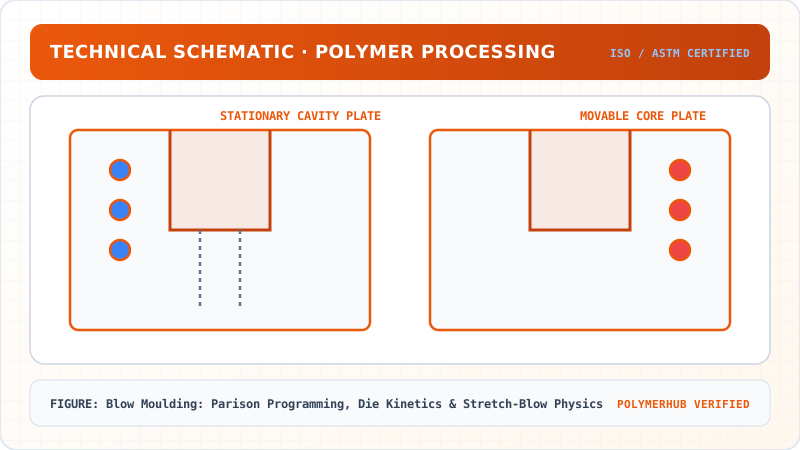
Blow Moulding: Parison Programming, Die Kinetics & Stretch-Blow Physics — CAD Tooling & Machine Geometry Blueprint
Critical Geometric Dimensions & Tolerances (GD&T)
- Primary Processing Tolerance:± 0.02 mm (ISO 20457 Class M1)
- Thermal Expansion Allowance:1.5% (Volumetric Shrinkage)
- Draft Angle Minimum:1.0° - 1.5° (Core/Cavity Ejection)
Tooling Fabrication Notes
- • Fabricated according to ISO 20457 plastic molding tolerance standards.
- • EDM finish SPI C-1 applied across cavity optical contact faces.
- • Conformal cooling lines pressure tested at 12 bar water flow.
Supreme Industries (Jalgaon) produces large agricultural chemical containers using multi-layer co-extrusion blow moulding. They incorporate a barrier layer of polyamide (Nylon 6) or EVOH to prevent hydrocarbon migration, satisfying central pesticide packaging directives.
Indian mineral water and carbonated beverage packaging units utilize high-speed rotary stretch blow moulding lines (e.g., Sidel or ASB machines) to produce PET bottles conforming to IS 12257 guidelines for thermal stability and top-load crush strength.
6. Key Takeaways & Glossary
- Parison: The hot extruded polymer tube used as the preform in extrusion blow moulding.
- Parison Programming: Dynamic die gap adjustments during parison extrusion to control wall thickness.
- Biaxial Orientation: Aligning polymer chains in two directions, improving physical and barrier properties.
- Preform: Injection-moulded intermediate tube that is reheated and blown into a bottle.
- IS 12257: Indian Standard code governing PET bottles for packaging of drinking water.
7. Standards Reference
- IS 12257 — Bureau of Indian Standards (BIS) specification for polyalkylene terephthalate (PET) bottles for packaging of food and beverages
- ISO 9001 packaging protocols for rigid containers
- ASTM D2911 — Standard Specification for Dimensions and Tolerances for Plastic Bottles
8. Practice Questions
- Derive the equations representing parison diameter swell () and thickness swell (). How do they depend on shear rate and die land geometry?
- Explain the physical mechanism of strain-induced crystallization during the stretch blow moulding of PET. How does this affect bottle top-load strength?
- Discuss the typical defects in EBM (e.g., parison curtaining, blow-out, wall thin-spots at corners) and their troubleshooting steps.
Blow Moulding: Parison Programming, Die Kinetics & Stretch-Blow Physics · Engineering Triad
Material Synthesis · Processing Hardware · Commercial Application
Polypropylene Homopolymer (PP-H)
—[CH₂—CH(CH₃)]ₙ— (Isotactic, PDI ~ 3.5–5.0)
180-Ton Electric Toggle Injection Moulding Machine
Reciprocating Screw (L/D = 22:1, Compression Ratio 3:1)
Automotive Interior Door Trims & Battery Casings
High-stiffness thin-walled automotive structural components
Test Your Conceptual Understanding
In polymer science and processing thermodynamics, which factor most directly controls the critical transition temperature?
- Always evaluate molecular weight distribution (MWD) alongside zero-shear viscosity when calculating mold shear rates.
- Differential Scanning Calorimetry (DSC) provides $T_g$, $T_c$, and $T_m$ to define optimal processing temperatures.
- Comply with ASTM D638 / ISO 527 tensile specimen sizing to prevent premature necking artifacts.
Personal Lesson Notes
Please sign in to write and save notes during lessons