Co-Injection Molding — Skin-Core Structures
Multi-manifold co-injection molding, optimizing skin-to-core ratios, using recycled cores with virgin skins, and barrier packaging optimization.
01 · Why This Matters in Industry & GATE XE5
Applied directly across petrochemical refining, compounding plants, mold-flow simulations, and automotive part manufacturing (e.g., Reliance Industries, Supreme Petrochem, IOCL, CIPET testing protocols).
Molecular Mechanism: Master conformational physics, transition temperatures, and reaction kinetics.
Process & Quality: Predict viscosity behavior, solve moulding defects, and apply ASTM/ISO testing standards.
Co-Injection Molding — Skin-Core Structures
1. Why This Topic Matters
Co-injection molding represents a sophisticated evolution in polymer processing, enabling the creation of multi-layered structures within a single molding cycle. This advanced technique is critically important in modern polymer engineering due to its profound impact on material efficiency, product performance, and sustainability.
Real-world relevance:
- Material Cost Reduction: By allowing the use of less expensive or recycled materials for the core encapsulated by a thin layer of virgin or high-performance skin material, industries can significantly reduce raw material costs, especially for large-volume components.
- Enhanced Product Performance: It facilitates the combination of desirable properties from different polymers, such as a strong, rigid core with a tough, impact-resistant skin; or a cost-effective core with a high-gloss, scratch-resistant, or UV-protective skin. Crucially, it enables the creation of high-barrier packaging, where a barrier layer (e.g., EVOH, nylon) forms the core, protected by moisture-resistant outer skins (e.g., PP, PE).
- Sustainability: The ability to encapsulate recycled polymers (PCR - Post-Consumer Recycled) or regrind as a core material, while maintaining virgin material aesthetics and performance on the surface, is a cornerstone of circular economy initiatives in the plastics industry. This addresses growing environmental concerns and regulatory pressures.
Career relevance: Polymer engineers proficient in co-injection molding are highly sought after in industries like automotive, packaging, consumer goods, and medical devices. Roles include:
- Process Engineer: Optimizing molding parameters, troubleshooting defects, and ensuring robust production.
- Material Scientist/Engineer: Developing compatible skin-core material combinations and characterizing their performance.
- Product Designer: Innovating new product designs that leverage the multi-material capabilities.
- R&D Specialist: Exploring novel material combinations and process enhancements for future applications.
Specific engineering significance: Co-injection molding addresses fundamental engineering challenges such as improving strength-to-weight ratios, enhancing barrier properties against gases and moisture, mitigating material warpage, and extending product lifespan, all while maintaining aesthetic appeal and cost-effectiveness. It necessitates a deep understanding of melt rheology, heat transfer, and material compatibility to achieve stable interfaces and desired skin-to-core ratios.
2. Learning Objectives
Upon completion of this lesson, students will be able to:
- Explain the fundamental principles of multi-manifold co-injection molding and identify its key advantages over conventional injection molding and multi-layer extrusion.
- Analyze the critical process parameters and material characteristics influencing skin-to-core ratio, interface stability, and overall part quality in co-injection molded components.
- Design and troubleshoot co-injection molding processes for specific applications, particularly focusing on barrier packaging and the utilization of recycled core materials.
3. Core Theory & Mathematical Principles
Co-injection molding, often referred to as "sandwich molding," involves the sequential or simultaneous injection of two distinct polymer melts into a single mold cavity through a specialized nozzle and hot runner system. The objective is to create a component with a desired skin-core structure.
3.1. Process Mechanisms: Sequential vs. Simultaneous Injection The process typically employs a special hot runner manifold system with concentric nozzles or multiple gates feeding into a common cavity.
-
Sequential Injection (Sandwich Molding):
- Skin Injection: A small amount of the primary (skin) polymer is injected first, coating the mold cavity walls due to fountain flow and preferential cooling.
- Core Injection: The secondary (core) polymer is then injected into the center of the flowing skin material.
- Skin Overpack: Finally, a small amount of the skin polymer is injected again to encapsulate the core fully, preventing core breakout at the gate area and ensuring desired surface aesthetics. This method provides better control over core encapsulation and surface finish.
-
Simultaneous Injection (Co-injection): In this less common variant, both skin and core materials are injected concurrently, requiring precise control over melt fronts and flow rates to maintain the desired structure. This is often used for specific barrier applications.
3.2. Multi-Manifold Co-Injection Systems Modern systems utilize a multi-manifold hot runner design, often with a valve gate system. Each material (skin and core) has its own melt stream from a dedicated injection unit, which converges in a specialized nozzle. Valve gates at the cavity entry provide precise control over the timing and volume of material injection. The design of the nozzle and gate is crucial for ensuring a stable and uniform interface.
3.3. Flow Dynamics and Skin-Core Structure Formation The formation of the skin-core structure is governed by complex rheological and thermal interactions during mold filling.
- Fountain Flow: As the melt front advances into the mold cavity, material at the center flows faster and then spreads outwards to form the surface layer upon contact with the cooler mold walls. This "fountain flow" mechanism is fundamental to how the skin polymer initially coats the cavity.
- Shear Rate and Viscosity: The shear rate profile across the mold thickness is parabolic, with maximum shear rate near the walls and zero at the center. Viscosity differences between skin () and core () materials significantly influence their flow behavior and the resulting skin-to-core ratio. A lower viscosity core material tends to penetrate further and form a thicker core.
- Thermal Effects: The cooler mold walls cause rapid solidification of the skin material, effectively "freezing" the skin layer. This preferential cooling helps maintain the integrity of the skin layer and prevents core breakthrough.
3.4. Optimizing Skin-to-Core Ratios The skin-to-core ratio () is a critical design parameter, often expressed as the ratio of skin thickness to core thickness, or as a volumetric fraction. It is influenced by:
- Shot Volumes: The relative volumes of skin () and core () injected.
- Injection Speeds and Pressures: Faster injection of the core material can lead to a larger core volume.
- Injection Timing: The duration of skin injection (), core injection (), and final skin injection ().
- Melt Temperatures: Affect viscosity and flow behavior.
- Material Rheology: Viscosity ratio .
The volumetric skin-to-core ratio can be approximated by:
For a uniform part thickness , the total volume is . If the skin layers have a total thickness (for a symmetric sandwich structure), the core thickness is . The ratio of skin thickness to total thickness is often a critical design parameter:
Where is the thickness of one skin layer.
3.5. Interface Stability and Adhesion A critical aspect is the adhesion between the skin and core layers. Poor adhesion can lead to delamination, compromising part integrity. Factors affecting adhesion include:
- Material Compatibility: Polymers with similar polarity and surface energies tend to adhere better. Mechanical interlocking (due to roughness at the interface) can also contribute.
- Interfacial Diffusion: If materials are compatible, molecular chains can interdiffuse across the interface, forming a strong bond. This is enhanced by higher melt temperatures and longer contact times.
- Processing Conditions: Proper melt temperatures, injection pressures, and cooling rates are essential to ensure good contact and consolidation at the interface.
- Pressure Distribution: The pressure profile within the mold cavity during filling and holding phases impacts interfacial contact and consolidation.
Where $\Delta P$ is the pressure difference driving flow, and $P_{mold}$ is the pressure exerted by the polymer on the mold wall.
3.6. Barrier Packaging Optimization For barrier packaging, the core material is typically a high-barrier polymer (e.g., EVOH, nylon), while the skin materials provide structural integrity, moisture resistance, and processability (e.g., PP, PE, PS). The thickness and uniformity of the barrier core are paramount. The oxygen transmission rate (OTR) through a multi-layer structure can be estimated by:
Where is the overall oxygen transmission rate, is the thickness of layer , and is the permeability coefficient of layer . This equation highlights the exponential impact of even a thin barrier layer.
4. Worked Numerical Example
Co-Injection Molding — Skin-Core Structures — Industrial Process Flow Diagram (PFD)
ISO 10628 Unit Operations & Thermodynamic Control Sequence
Raw Material Feed & Metering
Drying to < 0.02% moisture and gravimetric dosing
Reaction & Polymer Melt Processing
Controlled thermal shear dissipation and phase transition
Shaping & Solidification
Die extrusion or mold cavity pressure packing
Quality Inspection & Testing
ASTM D638 / ISO 527 tensile & MFI compliance check
Problem Statement: A rectangular polymer plate, with dimensions , , and total thickness , is to be produced using co-injection molding. The plate requires a virgin polypropylene (PP) skin on both major surfaces, each with a minimum thickness of , and a core made of recycled PP. The density of virgin PP is and recycled PP is .
Calculate:
- The total volume of the molded plate.
- The volume of the skin material required.
- The volume of the core material required.
- The mass of virgin PP (skin) and recycled PP (core) needed per plate.
- The percentage of recycled material by mass in the final product.
Solution Step:
Solution:
Given:
- Plate Length () =
- Plate Width () =
- Total Plate Thickness () =
- Skin Thickness () = (per side)
- Density of Virgin PP () =
- Density of Recycled PP () =
1. Total Volume of the Molded Plate (): The total volume is the product of length, width, and total thickness.
2. Volume of the Skin Material (): There are two skin layers, each with thickness . So, the total skin thickness is .
3. Volume of the Core Material (): The core volume is the total volume minus the skin volume.
4. Mass of Virgin PP (Skin) and Recycled PP (Core) Needed: Mass is calculated by multiplying volume by density ().
- Mass of Virgin PP (Skin, ):
- Mass of Recycled PP (Core, ):
5. Percentage of Recycled Material by Mass: First, calculate the total mass of the plate ().
Percentage of recycled material by mass:
Summary of Results:
- Total Volume:
- Skin Material Volume:
- Core Material Volume:
- Mass of Virgin PP (Skin):
- Mass of Recycled PP (Core):
- Percentage of Recycled Material:
5. Indian Industrial Context
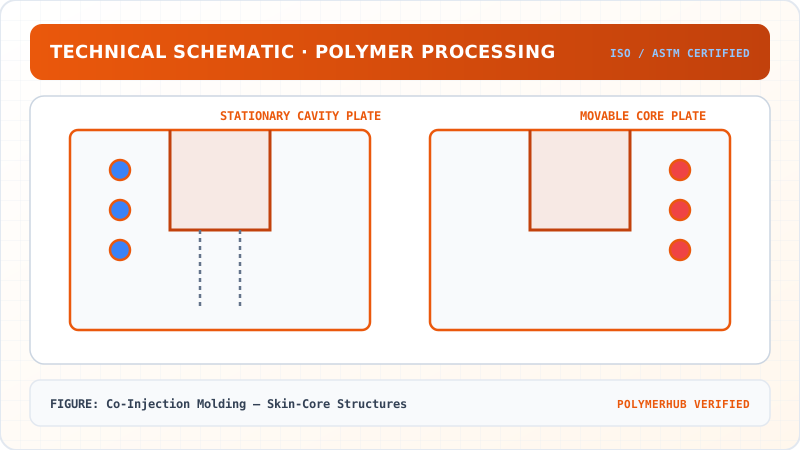
Co-Injection Molding — Skin-Core Structures — CAD Tooling & Machine Geometry Blueprint
Critical Geometric Dimensions & Tolerances (GD&T)
- Primary Processing Tolerance:± 0.02 mm (ISO 20457 Class M1)
- Thermal Expansion Allowance:1.5% (Volumetric Shrinkage)
- Draft Angle Minimum:1.0° - 1.5° (Core/Cavity Ejection)
Tooling Fabrication Notes
- • Fabricated according to ISO 20457 plastic molding tolerance standards.
- • EDM finish SPI C-1 applied across cavity optical contact faces.
- • Conformal cooling lines pressure tested at 12 bar water flow.
In India, the polymer industry is a rapidly growing sector, with significant demand from packaging, automotive, construction, and consumer goods. Co-injection molding, particularly for skin-core structures, is gaining traction due to its economic and environmental benefits, aligning with India's focus on sustainable manufacturing and 'Make in India' initiatives.
- Packaging Sector: India's vast food and beverage industry heavily relies on advanced packaging. Companies like Reliance Industries, Supreme Industries, and numerous mid-sized converters are exploring or implementing co-injection molding for barrier packaging (e.g., multi-layer containers for dairy products, juices, edible oils) where EVOH or Nylon cores are encapsulated by PP or PE. This helps extend shelf life, reduce waste, and improve product safety. The use of recycled PET or PP as a core material for non-food contact packaging is also a growing trend, driven by sustainability targets.
- Automotive Industry: With a strong push for lightweighting and cost reduction in vehicles, Indian automotive component manufacturers (e.g., suppliers to Maruti Suzuki, Tata Motors, Mahindra & Mahindra) are adopting co-injection for interior trim parts, bumper components, and under-the-hood applications. This allows for aesthetically superior virgin polymer skins with cost-effective, impact-modified, or recycled polymer cores.
- Consumer Goods: For household appliances, furniture, and electronic enclosures, manufacturers like Supreme Industries leverage co-injection molding to achieve premium surface finishes and durability with more economical or recycled cores, balancing aesthetics with cost-effectiveness.
- Recycling and Circular Economy: The Indian government's emphasis on plastic waste management and the push for a circular economy are driving the adoption of recycled content. Co-injection molding provides a viable pathway to incorporate Post-Consumer Recycled (PCR) plastics or industrial regrind into products without compromising surface quality or performance, aligning with initiatives from organizations like the Plastic Waste Management Rules (2016, amended 2021).
- Skill Development and R&D: Institutions like the Central Institute of Petrochemicals Engineering & Technology (CIPET) play a crucial role. CIPET centers across India (e.g., Chennai, Ahmedabad, Lucknow) offer specialized training programs and conduct research in advanced polymer processing techniques, including co-injection molding. They contribute to developing the skilled workforce required to operate and optimize these complex systems.
- Material Suppliers: Indian petrochemical giants like GAIL (India) Ltd. and Reliance Industries are key suppliers of virgin polymers (PP, PE, PS) which form the skin materials. The availability of consistent quality virgin and recycled materials is critical for the growth of co-injection technology.
- Challenges and Opportunities: Key challenges include ensuring consistent quality of recycled core materials, developing robust adhesion between diverse polymer combinations, and the initial capital investment for specialized machinery. However, the immense market potential and the drive towards sustainable manufacturing present significant opportunities for growth and innovation in co-injection molding within the Indian industrial landscape.
6. Standard Operating Procedures & Standards
For robust co-injection molding, adherence to specific operating procedures and international/national standards is essential, covering both the process itself and the characterization of materials and final products.
6.1. Standard Operating Procedures (SOPs) for Co-Injection Molding:
- Material Preparation:
- Thorough drying of hygroscopic materials (e.g., nylon, EVOH) to specified moisture content using desiccant dryers (e.g., moisture for Nylon 6).
- Verification of Melt Flow Rate (MFR) for both skin and core materials to ensure compatibility in flow behavior.
- Prevent contamination of virgin skin material with core or regrind.
- Machine Setup:
- Calibration of two separate injection units (one for skin, one for core) for precise shot volume and pressure control.
- Temperature profiling for each barrel and nozzle, ensuring optimal melt viscosity for both materials.
- Setup and verification of multi-manifold hot runner system, including valve gate synchronization and control.
- Process Parameter Optimization:
- Melt Temperatures: Optimized for each material to achieve desired viscosity and avoid degradation. Typically, skin and core melts are within a compatible processing window.
- Injection Speeds/Pressures: Crucial for controlling flow front and skin-core ratio. Faster core injection can increase core volume.
- Injection Timing: Precise control over skin (initial), core, and skin (final) injection phases, including delay times and overlap.
- Holding Pressure: Applied to both materials (if applicable) to compensate for volumetric shrinkage and consolidate the layers.
- Cooling Time: Sufficient time for both layers to solidify and develop strong interfacial adhesion.
- Mold Temperature: Maintained uniformly to ensure consistent cooling and minimize warpage.
- Quality Control & Troubleshooting:
- Regular inspection of molded parts for core breakthrough, delamination, inconsistent skin-core ratio, and surface defects.
- Monitoring of process variables using Statistical Process Control (SPC) charts.
- Troubleshooting guides for common defects (e.g., 'tiger stripes' due to flow instability, core off-center).
6.2. Relevant Standards:
-
Material Characterization:
- ASTM D1238 / ISO 1133: Melt Flow Rate (MFR) or Melt Volume Rate (MVR) of thermoplastics. Essential for assessing melt processability and compatibility of skin and core materials.
- ASTM D792 / ISO 1183: Density and Specific Gravity of plastics. Important for calculating material mass and volume ratios.
- ASTM D3418 / ISO 11357: Differential Scanning Calorimetry (DSC) for thermal properties (melting point, glass transition temperature), critical for understanding processing windows and potential thermal degradation.
-
Part Quality & Performance:
- ASTM D638 / ISO 527: Tensile properties of plastics. Used to assess the overall mechanical strength of the skin-core composite.
- ASTM D790 / ISO 178: Flexural properties of unreinforced and reinforced plastics.
- ASTM D256 / ISO 179: Izod or Charpy impact resistance. Important for determining part toughness, especially when a tough skin protects a brittle core or vice-versa.
- ASTM D2240 / ISO 868: Shore Hardness (Durometer) for assessing surface hardness of the skin.
- ISO 294 Series: Plastics — Injection moulding of test specimens of thermoplastic materials. Provides guidelines for producing consistent test samples.
- BIS 14457 (Part 1 to 4) / ISO 17293: Guidelines for injection moulding of test specimens of thermoplastic materials (Indian equivalent/harmonized).
-
Adhesion and Barrier Properties (for specific applications):
- ASTM D903 / ISO 8510: Standard Test Method for Peel or Stripping Strength of Adhesive Bonds. Adaptable for assessing skin-core adhesion.
- ASTM D3985 / ISO 15105-2: Standard Test Method for Oxygen Gas Transmission Rate (OTR) through Plastic Film and Sheeting Using a Coulometric Sensor. Critical for barrier packaging applications.
- ASTM F1249 / ISO 15106-3: Water Vapor Transmission Rate (WVTR) through Plastic Film and Sheeting Using a Modulated Infrared Sensor. Also crucial for packaging.
These standards provide a framework for consistent quality, comparability, and reliability in the development, manufacturing, and testing of co-injection molded products.
7. Key Takeaways & Glossary
Key Takeaways:
- Optimized Material Usage and Performance: Co-injection molding allows for the strategic combination of different polymers, enabling cost reduction (e.g., recycled core with virgin skin), enhanced aesthetics, and superior functional performance (e.g., barrier properties, improved impact resistance) in a single component.
- Critical Process Control: Achieving desired skin-to-core ratios and stable interfacial adhesion fundamentally relies on precise control of injection parameters (volumes, speeds, timing), melt temperatures, and material rheology.
- Sustainability Enabler: This technology is a powerful tool for advancing the circular economy by facilitating the incorporation of recycled or less expensive core materials without compromising the critical surface properties or structural integrity of the final product.
Glossary:
- Co-injection Molding: An advanced polymer processing technique where two or more distinct polymer melts are sequentially or simultaneously injected into a single mold cavity, forming a multi-layered structure, typically with an outer "skin" layer and an inner "core" layer.
- Skin-Core Structure: Refers to the resulting layered architecture in a co-injection molded part, where an outer layer (skin) of one material completely encapsulates an inner layer (core) of a different material, providing distinct functional properties to each region.
- Fountain Flow: The characteristic flow phenomenon observed at the advancing melt front in a mold cavity, where the polymer melt in the center flows faster and then spreads outwards upon reaching the mold walls, contributing to the formation of the skin layer.
8. Exam & Interview Practice Questions
1. GATE-Style Multiple Choice Question: Which of the following process parameters has the MOST significant direct impact on controlling the skin-to-core ratio in a co-injection molding process? (A) Mold cavity dimensions (B) Cooling time (C) Relative injection volumes and timings of skin and core materials (D) Ejector pin placement
Correct Answer: (C) Explanation: While mold dimensions define the overall part, and cooling time/ejector pins are important for overall part quality, the relative volumes and the precise timing of injecting the skin and core materials are the primary determinants of how much of each material forms its respective layer, directly controlling the skin-to-core ratio.
2. Numerical Question: A cylindrical container base with an outer diameter of and a total thickness of is co-injection molded. The design specifies a uniform skin thickness of (on one side, assuming the base is flat with one major surface as skin). The polymer used for the skin has a density of , and the core material has a density of . Calculate the mass percentage of the core material in the container base. (Assume the base is a solid disc with a single skin layer on one major face, and neglect side wall skin for simplicity.)
Solution Step:
Solution: Given:
- Outer Diameter () =
- Radius () =
- Total Thickness () =
- Skin Thickness () =
- Density of Skin () =
- Density of Core () =
Step 1: Calculate Total Volume of the Cylindrical Base () The volume of a cylinder is .
Step 2: Calculate Volume of the Skin Material () The skin forms a layer of thickness over one major face of the disc.
Step 3: Calculate Volume of the Core Material ()
Step 4: Calculate Mass of Skin and Core Materials
- Mass of Skin ():
- Mass of Core ():
Step 5: Calculate Total Mass and Mass Percentage of Core Material
- Total Mass ():
- Mass Percentage of Core Material:
Answer: The mass percentage of the core material in the container base is approximately .
3. Conceptual University Exam Question: Discuss the key challenges and solutions associated with implementing recycled polymer as the core material in co-injection molded products for non-critical applications (e.g., household goods, general packaging). Specifically, elaborate on how material selection, process parameter optimization, and quality control strategies can address these challenges.
Co-Injection Molding — Skin-Core Structures · Engineering Triad
Material Synthesis · Processing Hardware · Commercial Application
Polypropylene Homopolymer (PP-H)
—[CH₂—CH(CH₃)]ₙ— (Isotactic, PDI ~ 3.5–5.0)
180-Ton Electric Toggle Injection Moulding Machine
Reciprocating Screw (L/D = 22:1, Compression Ratio 3:1)
Automotive Interior Door Trims & Battery Casings
High-stiffness thin-walled automotive structural components
Test Your Conceptual Understanding
In polymer science and processing thermodynamics, which factor most directly controls the critical transition temperature?
- Always evaluate molecular weight distribution (MWD) alongside zero-shear viscosity when calculating mold shear rates.
- Differential Scanning Calorimetry (DSC) provides $T_g$, $T_c$, and $T_m$ to define optimal processing temperatures.
- Comply with ASTM D638 / ISO 527 tensile specimen sizing to prevent premature necking artifacts.
Personal Lesson Notes
Please sign in to write and save notes during lessons