Extrusion Die Design Fundamentals: Rheology, Pressure Drop & Land Geometry
Go deeper into die design principles — flow balancing, land length, and pressure drop calculations — the engineering behind producing dimensionally consistent extruded products at high speed.
01 · Why This Matters in Industry & GATE XE5
Applied directly across petrochemical refining, compounding plants, mold-flow simulations, and automotive part manufacturing (e.g., Reliance Industries, Supreme Petrochem, IOCL, CIPET testing protocols).
Molecular Mechanism: Master conformational physics, transition temperatures, and reaction kinetics.
Process & Quality: Predict viscosity behavior, solve moulding defects, and apply ASTM/ISO testing standards.
Extrusion Die Design Fundamentals: Rheology, Pressure Drop & Land Geometry
1. Why This Topic Matters
Extrusion dies shape molten polymer delivered by the extruder screw into continuous profiles, pipes, sheets, blown films, and wire insulations. Designing extrusion dies requires balancing flow distribution across complex die geometry, controlling pressure drops, preventing melt fracture, and accounting for post-extrusion die swell. Properly engineered coat-hanger sheet dies and annular pipe heads guarantee uniform wall thickness tolerances and high surface quality.
2. Learning Objectives
By completing this lesson, you will be able to:
- Design coat-hanger sheet dies, mandrel pipe heads, and profile dies for uniform melt velocity distribution.
- Calculate slit die pressure drop (), wall shear rate, and die swell ratio ().
- Compare coat-hanger vs T-die manifold distribution efficiencies.
- Diagnose flow instability, land length stress relaxation, and gauge variation defects.
3. Core Theory & Die Manifold Geometry
Coat-Hanger Die Principle
A coat-hanger die utilizes a contoured manifold channel coupled with a variable land length to ensure equal residence time and uniform volumetric flow rate across the entire width of extruded sheet.
graph TD
    A["Extruder Barrel Adapter"] --> B["Central Inlet Channel"]
    B --> C["Coat-Hanger Manifold (Tapered Cross-Section)"]
    C --> D["Pre-Land Channel (Shear Equalization Zone)"]
    D --> E["Final Parallel Die Land (Stress Relaxation Zone)"]
    E --> F["Extruded Polymer Sheet / Profile"]
4. Equations & Recalculated Worked Example
Extrusion Die Design Fundamentals: Rheology, Pressure Drop & Land Geometry — Industrial Process Flow Diagram (PFD)
ISO 10628 Unit Operations & Thermodynamic Control Sequence
Raw Material Feed & Metering
Drying to < 0.02% moisture and gravimetric dosing
Reaction & Polymer Melt Processing
Controlled thermal shear dissipation and phase transition
Shaping & Solidification
Die extrusion or mold cavity pressure packing
Quality Inspection & Testing
ASTM D638 / ISO 527 tensile & MFI compliance check
Slit Die Pressure Drop Equation
For a flat slit die of width , gap height , and land length under volumetric flow rate with power-law melt viscosity :
Worked Numerical Example:
Problem Statement:
Problem: High-Density Polyethylene (HDPE) melt flows through a coat-hanger flat sheet die of width (), gap height (), and die land length (). At operating shear rate, melt apparent viscosity , and volumetric throughput is (\approx. ). Calculate the pressure drop () across the die land in MPa.
Solution Step:
Solution:
- Calculate numerator:
- Calculate denominator:
- Calculate Pressure Drop ():
Engineering Note: Land length provides adequate stress relaxation to suppress sharkskin melt fracture while maintaining a manageable die pressure drop of .
5. Industrial Applications
Extrusion Die Design Fundamentals: Rheology, Pressure Drop & Land Geometry — CAD Tooling & Machine Geometry Blueprint
Critical Geometric Dimensions & Tolerances (GD&T)
- Primary Processing Tolerance:± 0.02 mm (ISO 20457 Class M1)
- Thermal Expansion Allowance:1.5% (Volumetric Shrinkage)
- Draft Angle Minimum:1.0° - 1.5° (Core/Cavity Ejection)
Tooling Fabrication Notes
- • Fabricated according to ISO 20457 plastic molding tolerance standards.
- • EDM finish SPI C-1 applied across cavity optical contact faces.
- • Conformal cooling lines pressure tested at 12 bar water flow.
- Cast Film & Sheet Extrusion: Coat-hanger dies producing wide PP/PS packaging sheet. (Illustrative Indian industry scenario based on sheet extrusion plants in Vadodara).
- HDPE Pipe Extrusion: Spiral mandrel annular dies for pressure pipe extrusion up to diameter.
6. Key Takeaways & Glossary
- Die Land (): Parallel final section of die channel providing stress relaxation before melt exits.
- Die Swell (): Elastic recovery expansion of extrudate upon exiting die restraint.
- Coat-Hanger Manifold: Tapered internal channel providing constant shear rate across sheet width.
7. Sources & Standard References
- Rauwendaal, C. (2014). Polymer Extrusion, 5th Ed., Hanser.
- VDI 2006 — Extrusion Dies for Plastics: Design Principles and Flow Analysis.
Extrusion Die Design Fundamentals: Rheology, Pressure Drop & Land Geometry · Engineering Triad
Material Synthesis · Processing Hardware · Commercial Application
Polypropylene Homopolymer (PP-H)
—[CH₂—CH(CH₃)]ₙ— (Isotactic, PDI ~ 3.5–5.0)
180-Ton Electric Toggle Injection Moulding Machine
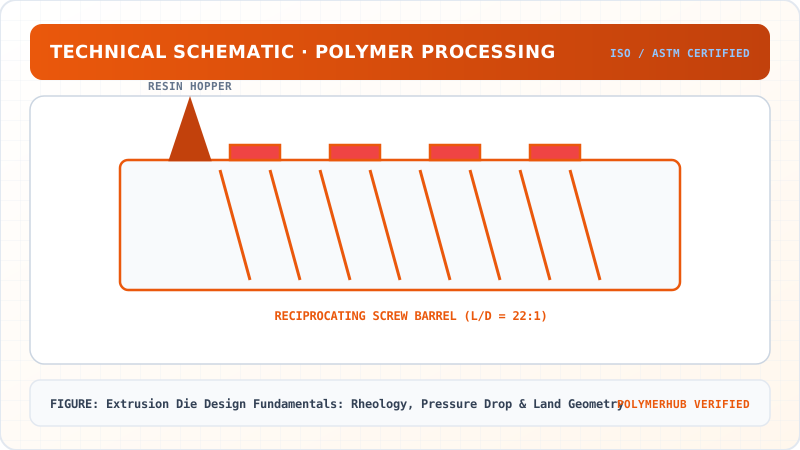
Reciprocating Screw (L/D = 22:1, Compression Ratio 3:1)
Automotive Interior Door Trims & Battery Casings
High-stiffness thin-walled automotive structural components
Test Your Conceptual Understanding
In polymer science and processing thermodynamics, which factor most directly controls the critical transition temperature?
- Always evaluate molecular weight distribution (MWD) alongside zero-shear viscosity when calculating mold shear rates.
- Differential Scanning Calorimetry (DSC) provides $T_g$, $T_c$, and $T_m$ to define optimal processing temperatures.
- Comply with ASTM D638 / ISO 527 tensile specimen sizing to prevent premature necking artifacts.
Personal Lesson Notes
Please sign in to write and save notes during lessons