Extrusion Melt Fracture: Sharkskin, Stick–Slip & Gross Distortion Mechanics
Melt fracture flow instabilities, critical wall shear stress, sharkskin surface roughness, stick-slip oscillating flow, gross melt fracture, and fluoropolymer PPAs.
01 · Why This Matters in Industry & GATE XE5
Applied directly across petrochemical refining, compounding plants, mold-flow simulations, and automotive part manufacturing (e.g., Reliance Industries, Supreme Petrochem, IOCL, CIPET testing protocols).
Molecular Mechanism: Master conformational physics, transition temperatures, and reaction kinetics.
Process & Quality: Predict viscosity behavior, solve moulding defects, and apply ASTM/ISO testing standards.
Extrusion Melt Fracture: Sharkskin, Stick–Slip & Gross Distortion Mechanics
1. Why This Topic Matters
In high-speed extrusion (blown film, pipe, wire coating), the rate of production is limited by the onset of flow instabilities known as melt fracture. Melt fracture causes surface defects ranging from a loss of gloss (sharkskin) to severe helical distortion of the extrudate. These defects degrade aesthetics and compromise mechanical properties. Extrusion engineers at Indian raw material producers (e.g., Reliance Industries) and packaging processors must understand the viscoelastic mechanisms behind these instabilities to design polymer processing aids (PPAs) and die profiles that prevent them.
2. Learning Objectives
- Classify the three primary types of melt fracture (sharkskin, stick-slip, gross distortion) by appearance and flow regime.
- Explain the role of wall shear stress () and critical shear rate in initiating instabilities.
- Analyze the mechanism of sharkskin formation due to tensile stress concentration at the die exit.
- Describe how fluoropolymer processing aids (PPAs) eliminate stick-slip melt fracture.
- Reference rheological standards and instability diagnostics.
3. Core Theory
3.1 Types of Melt Fracture
As the extrusion throughput (shear rate) increases, flow instabilities progress through three stages:
- Sharkskin (Surface Melt Fracture): A matte finish or ridge-like surface roughness. Occurs at the die exit due to rapid stretching of the outer melt layer as it transitions from zero wall velocity to free-surface flow.
- Stick-Slip (Spurt) Flow: Alternating smooth and rough regions on the extrudate, accompanied by pressure oscillations. Occurs inside the die land when the wall shear stress exceeds a critical limit, causing the polymer to slip and re-stick along the wall.
- Gross Melt Fracture: Severe helical or chaotic distortion of the entire extrudate. Initiates at the die entry due to elastic vortices and unstable entry flow.
3.2 Critical Stress Limits
Melt instabilities correlate with wall shear stress :
- Sharkskin onset: MPa.
- Stick-slip onset: MPa.
3.3 Elimination via Polymer Processing Aids (PPAs)
Fluoropolymer processing aids (PPAs, e.g., PVDF-HFP copolymers) are added at low concentrations ( ppm):
- The fluoropolymer is incompatible with the polyolefin melt.
- It migrates to the die wall due to low surface energy.
- It coats the steel die surface, forming a low-friction layer.
- This coating promotes controlled wall slip, lowering the wall shear stress below the critical threshold to eliminate sharkskin and stick-slip.
4. Worked Example
Extrusion Melt Fracture: Sharkskin, Stick–Slip & Gross Distortion Mechanics — Industrial Process Flow Diagram (PFD)
ISO 10628 Unit Operations & Thermodynamic Control Sequence
Raw Material Feed & Metering
Drying to < 0.02% moisture and gravimetric dosing
Reaction & Polymer Melt Processing
Controlled thermal shear dissipation and phase transition
Shaping & Solidification
Die extrusion or mold cavity pressure packing
Quality Inspection & Testing
ASTM D638 / ISO 527 tensile & MFI compliance check
Problem Statement:
Problem: A capillary rheometer test is conducted on an LLDPE melt at 190°C. The capillary die has a diameter mm and length mm. At a flow rate m³/s, the pressure drop across the die is MPa, and the extrudate displays sharkskin. Calculate:
- The wall shear stress () in MPa.
- Compare this value with the typical sharkskin critical stress threshold ( MPa) and determine if it explains the defect.
Solution Step:
Solution:
- Calculate the wall shear stress using the capillary flow equation:
Interpretation: The calculated wall shear stress is 0.20 MPa. Since this exceeds the critical sharkskin threshold of 0.12 MPa, it explains the onset of surface melt fracture. The engineer should add 500 ppm of a fluoropolymer PPA or increase the die diameter to lower the wall shear stress.
5. Indian Industry Context
Extrusion Melt Fracture: Sharkskin, Stick–Slip & Gross Distortion Mechanics — CAD Tooling & Machine Geometry Blueprint
Critical Geometric Dimensions & Tolerances (GD&T)
- Primary Processing Tolerance:± 0.02 mm (ISO 20457 Class M1)
- Thermal Expansion Allowance:1.5% (Volumetric Shrinkage)
- Draft Angle Minimum:1.0° - 1.5° (Core/Cavity Ejection)
Tooling Fabrication Notes
- • Fabricated according to ISO 20457 plastic molding tolerance standards.
- • EDM finish SPI C-1 applied across cavity optical contact faces.
- • Conformal cooling lines pressure tested at 12 bar water flow.
Reliance Industries Limited (RIL) produces LLDPE film grades (e.g., Relene) for the packaging market. These grades are pre-compounded with fluoropolymer PPAs to allow high-speed film blowing on modern extrusion lines without the risk of sharkskin.
6. Key Takeaways & Glossary
- Sharkskin: Surface defect caused by high tensile stresses stretching the melt at the die exit.
- Stick-Slip: Flow transition accompanied by pressure fluctuations, caused by periodic polymer slip at the die wall.
- Gross Melt Fracture: Severe structural distortion initiating at the die entry zone.
- PPA: Polymer Processing Aid; fluoropolymer additive promoting wall slip to eliminate melt fracture.
- Z\eta Potential: (Not applicable, colloidal term).
7. Standards Reference
- ASTM D3835 — Standard Test Method for Determination of Properties of Polymeric Materials by Means of a Capillary Rheometer
- ISO 11443 — Plastics — Determination of the fluidity of plastics using capillary and slit-die rheometers
8. Practice Questions
- Explain the molecular stretching mechanism that occurs at the exit edge of the die land, and why this causes sharkskin.
- How does the molecular weight distribution (MWD) and long-chain branching (LCB) of a polymer melt affect its critical shear stress for melt fracture?
- Sketch a typical shear stress versus shear rate curve for a polymer melt showing the stick-slip discontinuity region.
Extrusion Melt Fracture: Sharkskin, Stick–Slip & Gross Distortion Mechanics · Engineering Triad
Material Synthesis · Processing Hardware · Commercial Application
Polypropylene Homopolymer (PP-H)
—[CH₂—CH(CH₃)]ₙ— (Isotactic, PDI ~ 3.5–5.0)
180-Ton Electric Toggle Injection Moulding Machine
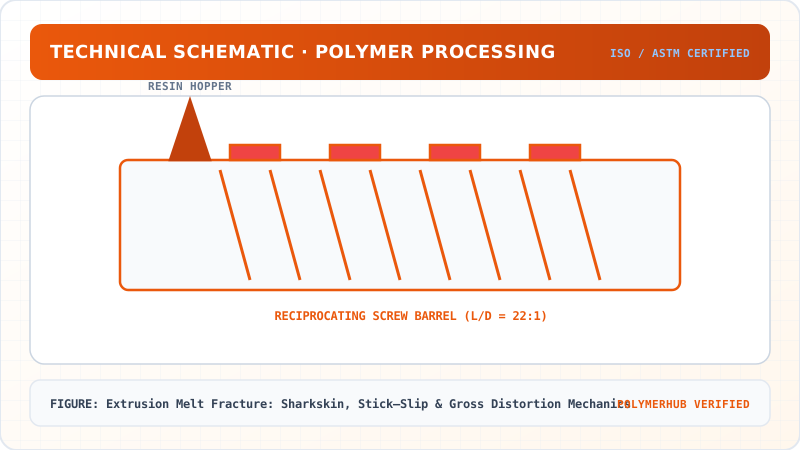
Reciprocating Screw (L/D = 22:1, Compression Ratio 3:1)
Automotive Interior Door Trims & Battery Casings
High-stiffness thin-walled automotive structural components
Test Your Conceptual Understanding
In polymer science and processing thermodynamics, which factor most directly controls the critical transition temperature?
- Always evaluate molecular weight distribution (MWD) alongside zero-shear viscosity when calculating mold shear rates.
- Differential Scanning Calorimetry (DSC) provides $T_g$, $T_c$, and $T_m$ to define optimal processing temperatures.
- Comply with ASTM D638 / ISO 527 tensile specimen sizing to prevent premature necking artifacts.
Personal Lesson Notes
Please sign in to write and save notes during lessons