Extrusion Die Swell, Drawdown & Dimensional Control: Viscoelasticity & Land Length Physics
Applied extrudate swell ratio B, drawdown ratio DDR, haul-off velocity, vacuum sizing calibrator heat transfer, and wall thickness tolerance control.
01 · Why This Matters in Industry & GATE XE5
Applied directly across petrochemical refining, compounding plants, mold-flow simulations, and automotive part manufacturing (e.g., Reliance Industries, Supreme Petrochem, IOCL, CIPET testing protocols).
Molecular Mechanism: Master conformational physics, transition temperatures, and reaction kinetics.
Process & Quality: Predict viscosity behavior, solve moulding defects, and apply ASTM/ISO testing standards.
Extrusion Die Swell, Drawdown & Dimensional Control: Viscoelasticity & Land Length Physics
1. Why This Topic Matters
Extrusion profile manufacturing (e.g., pipes, window profiles, tubes) relies on precise dimensional control. Polymer melts are viscoelastic; as they emerge from the die, they experience die swell due to the relaxation of oriented polymer chains. Simultaneously, downstream pulling systems introduce drawdown, which stretches and thins the profile. Balancing die swell and drawdown requires precise calibration of die land length and cooling bath pull speeds. Indian pipe makers like Supreme Industries and Astral Pipes optimize these settings to meet strict dimensional tolerances.
2. Learning Objectives
- Explain the viscoelastic origin of die swell (extrudate swell) and its relationship to normal stress differences ().
- Formulate the effect of die land length ( ratio) on shear stress relaxation and die swell reduction.
- Calculate the drawdown ratio (DDR) and its effect on final extrudate dimensions.
- Design a die sizing adjustment profile to compensate for predictable die swell and drawdown.
- Reference extrusion quality standards such as IS 4985 (PVC pipes) and ISO 3126.
3. Core Theory
3.1 Viscoelastic Origin of Die Swell
As a polymer melt flows through a die, the shear field aligns and stretches the polymer chains. When the melt exits the die land:
- The confining wall stresses are removed.
- The polymer chains retract to their random coil state (elastic recovery).
- This causes a contraction in the flow direction and an expansion in the transverse direction (die swell). Die swell ratio is:
3.2 Role of Land Length () in Stress Relaxation
The longer the melt remains in a parallel channel (die land), the more time the polymer chains have to relax their elastic stress before exiting. Increasing the land length () reduces die swell:
Where is the residence time in the die land () and is the relaxation time of the melt. Typical land lengths range from to depending on the polymer elasticity.
3.3 Drawdown Mechanics
Downstream puller systems (haul-offs) pull the extrudate at a speed greater than the die exit velocity . This stretches the melt while it is still warm:
Where is the die cross-sectional area and is the final solidified product cross-sectional area. Drawdown reduces profile dimensions, counteracting die swell.
4. Worked Example
Extrusion Die Swell, Drawdown & Dimensional Control: Viscoelasticity & Land Length Physics — Industrial Process Flow Diagram (PFD)
ISO 10628 Unit Operations & Thermodynamic Control Sequence
Raw Material Feed & Metering
Drying to < 0.02% moisture and gravimetric dosing
Reaction & Polymer Melt Processing
Controlled thermal shear dissipation and phase transition
Shaping & Solidification
Die extrusion or mold cavity pressure packing
Quality Inspection & Testing
ASTM D638 / ISO 527 tensile & MFI compliance check
Problem Statement:
Problem: A HDPE pipe is extruded using a die with an outer diameter mm and wall thickness mm. The melt has a die swell ratio . The downstream puller is adjusted to pull the pipe at a speed that yields a Drawdown Ratio . Calculate:
- The intermediate outer diameter of the extrudate after die swell but before drawdown.
- The final outer diameter of the solidified pipe ().
Solution Step:
Solution:
- Calculate the intermediate diameter () using the die swell ratio:
- Calculate the final diameter () incorporating drawdown. The cross-sectional dimensions scale inversely with the square root of the drawdown velocity ratio (for isotropic scaling):
Interpretation: The extrusion die outputs melt at 50.0 mm. Viscoelastic expansion swells the profile to 65.0 mm, and downstream tension draws it down to a final product outer diameter of 59.34 mm. Sizing sleeves must be positioned to calibrate this final diameter to target specifications.
5. Indian Industry Context
Extrusion Die Swell, Drawdown & Dimensional Control: Viscoelasticity & Land Length Physics — CAD Tooling & Machine Geometry Blueprint
Critical Geometric Dimensions & Tolerances (GD&T)
- Primary Processing Tolerance:± 0.02 mm (ISO 20457 Class M1)
- Thermal Expansion Allowance:1.5% (Volumetric Shrinkage)
- Draft Angle Minimum:1.0° - 1.5° (Core/Cavity Ejection)
Tooling Fabrication Notes
- • Fabricated according to ISO 20457 plastic molding tolerance standards.
- • EDM finish SPI C-1 applied across cavity optical contact faces.
- • Conformal cooling lines pressure tested at 12 bar water flow.
Supreme Industries (Gadegaon, Maharashtra) and Astral Pipes (Ahmedabad) manufacture chlorinated PVC (CPVC) and lead-free PVC pipes. Their extrusion lines utilize vacuum calibrator tanks with brass sizing sleeves to clamp the pipe outer diameter under vacuum, cooling the swollen extrudate to meet IS 4985 tolerances.
Indian toolrooms adjust land length configurations based on whether they process highly elastic LDPE (requiring ) or low-elasticity PP ().
6. Key Takeaways & Glossary
- Die Swell (Barus Effect): Transverse expansion of extrudate due to polymer chain relaxation.
- Land Length (): The parallel portion of the die exit channel where stress relaxation occurs.
- Drawdown Ratio (DDR): Ratio of puller speed to die exit speed, resulting in profile thinning.
- Sizing Sleeve: A water-cooled sleeve located at the cooling tank entrance to calibrate pipe outer dimensions.
- IS 4985: Indian Standard code governing unplasticized PVC pipes for potable water supply.
7. Standards Reference
- IS 4985 — Bureau of Indian Standards (BIS) code for unplasticized PVC pipes for water supply
- ISO 3126 — Plastics piping systems — Plastics components — Determination of dimensions
- ASTM D2837 — Standard Test Method for Obtaining Hydrostatic Design Basis for Thermoplastic Pipe Materials
- ISO 11443 — Plastics — Determination of the fluidity of plastics using capillary rheometers
8. Practice Questions
- Derive the relationship between melt residence time in the die land and the reduction of die swell using a single Maxwell relaxation model.
- How does the molecular weight distribution (MWD) of polyethylene influence its die swell behavior? Compare narrow MWD metallocene PE with broad MWD unimodal PE.
- Describe the defects associated with excessive drawdown (e.g., draw resonance, melt tear) and their mitigation.
Extrusion Die Swell, Drawdown & Dimensional Control: Viscoelasticity & Land Length Physics · Engineering Triad
Material Synthesis · Processing Hardware · Commercial Application
Polypropylene Homopolymer (PP-H)
—[CH₂—CH(CH₃)]ₙ— (Isotactic, PDI ~ 3.5–5.0)
180-Ton Electric Toggle Injection Moulding Machine
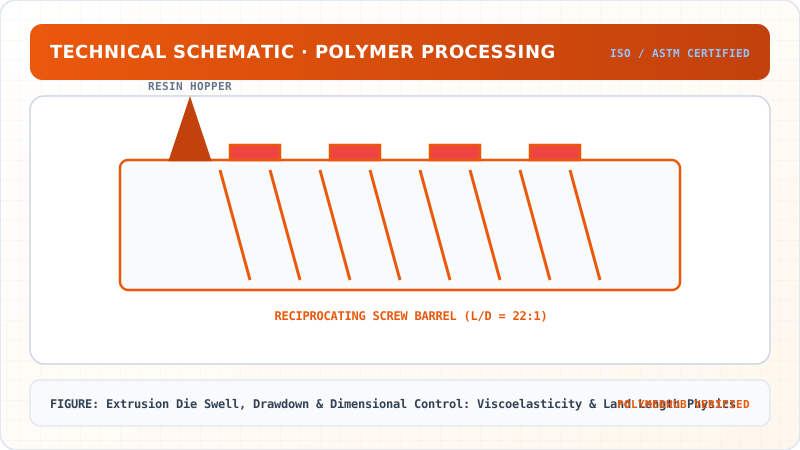
Reciprocating Screw (L/D = 22:1, Compression Ratio 3:1)
Automotive Interior Door Trims & Battery Casings
High-stiffness thin-walled automotive structural components
Test Your Conceptual Understanding
In polymer science and processing thermodynamics, which factor most directly controls the critical transition temperature?
- Always evaluate molecular weight distribution (MWD) alongside zero-shear viscosity when calculating mold shear rates.
- Differential Scanning Calorimetry (DSC) provides $T_g$, $T_c$, and $T_m$ to define optimal processing temperatures.
- Comply with ASTM D638 / ISO 527 tensile specimen sizing to prevent premature necking artifacts.
Personal Lesson Notes
Please sign in to write and save notes during lessons