Gas-Assisted Injection Molding — Principles & Design
Process engineering of gas-assisted injection molding, nitrogen injection pathways, hollow part design, sink mark elimination, and cycle time reduction.
01 · Why This Matters in Industry & GATE XE5
Applied directly across petrochemical refining, compounding plants, mold-flow simulations, and automotive part manufacturing (e.g., Reliance Industries, Supreme Petrochem, IOCL, CIPET testing protocols).
Molecular Mechanism: Master conformational physics, transition temperatures, and reaction kinetics.
Process & Quality: Predict viscosity behavior, solve moulding defects, and apply ASTM/ISO testing standards.
Gas-Assisted Injection Molding — Principles & Design
1. Why This Topic Matters
Gas-Assisted Injection Molding (GAIM) represents a pivotal advancement in polymer processing, enabling the manufacture of complex, high-quality plastic parts with significantly enhanced performance characteristics. From an engineering perspective, GAIM addresses several fundamental limitations of conventional injection molding, such as sink marks, warpage, high part weight, and prolonged cycle times. This technology allows for greater design freedom, enabling the creation of intricate hollow structures and parts with varying wall thicknesses that would be otherwise difficult or impossible to produce conventionally.
For polymer engineering students in India, understanding GAIM is crucial for several reasons:
- Real-world relevance: Industries such as automotive (dashboards, door handles, spoilers), consumer electronics (housings, frames), furniture (chairs, tables), and white goods extensively utilize GAIM to produce lightweight yet robust components. As India's manufacturing sector grows, the demand for such advanced processing techniques is escalating.
- Career relevance: Proficiency in GAIM principles and design equips future engineers with specialized skills highly valued in R&D, process optimization, mold design, and production management roles within the plastics industry. It positions graduates to innovate and implement sustainable manufacturing solutions by reducing material consumption and energy footprint.
- Specific engineering significance: GAIM offers a sophisticated solution to improve part aesthetics (eliminating sink marks), structural integrity (reducing warpage, increasing stiffness-to-weight ratio), and cost-effectiveness (material savings, reduced cycle times). Mastering this technology is essential for designing high-performance polymer products that meet stringent quality and economic demands.
2. Learning Objectives
Upon completion of this lesson, students will be able to:
- Explain the fundamental principles and operational sequences of Gas-Assisted Injection Molding, including the role of nitrogen gas in cavity packing and core-out.
- Analyze various nitrogen injection strategies (e.g., short shot, full shot, overflow) and their implications for part design, gas channel placement, and resultant mechanical properties.
- Evaluate the engineering benefits of GAIM, such as sink mark elimination, warpage reduction, material savings, and cycle time optimization, in the context of specific industrial applications.
3. Core Theory & Mathematical Principles
Gas-Assisted Injection Molding (GAIM) is a specialized injection molding process where a controlled volume of inert gas, typically high-pressure nitrogen, is injected into the molten polymer stream or directly into the mold cavity during or after the polymer injection phase. This gas creates an internal channel or hollow core within the part, acting as an internal packing medium.
Process Sequence:
- Partial/Full Polymer Shot: A predetermined volume of molten polymer is injected into the mold cavity. This can be a "short shot" (partially filling the cavity) or a "full shot" (completely filling the cavity).
- Gas Injection: High-pressure nitrogen gas is injected into the molten polymer either through a gas pin (direct injection) or a gas nozzle (melt stream injection). The gas pressure typically ranges from 50 to 300 bar.
- Gas Penetration & Core-Out: The gas, being less viscous, preferentially flows through the hot, low-viscosity core of the polymer melt, displacing it and creating a hollow channel. The gas acts as an internal ram, pushing the polymer into unfilled regions of the mold and compensating for shrinkage.
- Packing & Holding: The gas pressure is maintained for a specific duration, continuing to pack the part and prevent sink marks and voids as the polymer cools and shrinks.
- Cooling & Decompression: The part cools, and the gas pressure is vented.
- Ejection: The finished part is ejected from the mold.
Nitrogen Injection Pathways:
- Short Shot (Plastic first, Gas second): The mold cavity is partially filled with polymer (e.g., 70-90% volume). Gas is then injected, pushing the polymer to fill the remaining cavity and simultaneously creating the hollow core. This is common for parts with complex geometries and long flow lengths.
- Full Shot (Melt displacement): The mold cavity is completely filled with polymer. Gas is then injected, displacing a portion of the molten polymer out of the cavity into an overflow well or back into the barrel. This is effective for reducing material density and achieving uniform packing.
- Overflow (Venturi effect): Polymer is injected into the mold cavity, and gas is injected into a runner system that leads to an overflow cavity. The gas pressure pushes polymer from the main cavity into the overflow, creating a hollow section. This can be useful for parts where direct gas injection is difficult.
Design Considerations:
- Gas Channel Design: Optimal design of gas channels within the part is crucial for uniform gas penetration and efficient core-out. Channels are typically designed as ribs, bosses, or thick sections that allow the gas to flow.
- Wall Thickness Variation: GAIM excels in parts with varying wall thicknesses, as the gas can preferentially core out thicker sections, thus preventing sink marks and reducing overall mass.
- Gate Location: Strategically placed gates ensure proper polymer flow before gas injection.
- Gas Pin Location: The location of the gas pin/nozzle determines the direction and extent of gas penetration.
Mathematical Principles:
- Gas Penetration Pressure: The gas must exert sufficient pressure to overcome the polymer melt pressure and viscosity.
where $P_{gas}$ is the gas injection pressure, $P_{polymer\_melt}$ is the local polymer melt pressure, and $\Delta P_{flow}$ accounts for flow resistance.
2. Volume of Gas Required: The volume of gas injected (at process conditions) is roughly proportional to the desired hollow volume, considering gas compressibility and thermal expansion.
where $V_{hollow}$ is the target hollow volume, $\rho_{polymer}$ is the polymer density, $\rho_{gas, final}$ is the gas density at the final temperature and pressure in the part, and $\alpha$ is an efficiency factor (typically > 1 due to gas compressibility and potential losses).
3. Material Savings: The percentage of material saved is directly related to the volume of the hollow section.
where $V_{solid}$ is the volume of the equivalent solid part.
The actual mass saved per part:
- Cycle Time Reduction: GAIM typically reduces cooling time due to thinner effective wall sections and reduced packing time as gas provides internal pressure. An empirical estimate for cycle time reduction:
where $t_{conv}$ is the conventional cycle time and $t_{GAIM}$ is the GAIM cycle time. The reduction is often attributed to the gas pressure assisting packing and thinner sections allowing faster heat transfer. The cooling time $t_c$ for a polymer part is approximated by:
where $H$ is the characteristic thickness and $\alpha_{therm}$ is thermal diffusivity. By creating a hollow core, the effective thickness for heat transfer from the core is reduced.
5. Pressure Gradient in Gas Channel (Approximation): For uniform gas penetration, the pressure drop along the gas channel should be minimized. This can be qualitatively related to Poiseuille's Law for fluid flow in a channel, where for a cylindrical channel:
While gas flow is compressible, this highlights that larger radius ($r$) and shorter length ($L$) channels minimize pressure drop, facilitating uniform penetration. Here, $\mu$ is gas viscosity, $Q$ is gas flow rate.
4. Worked Numerical Example
Gas-Assisted Injection Molding — Principles & Design — Industrial Process Flow Diagram (PFD)
ISO 10628 Unit Operations & Thermodynamic Control Sequence
Raw Material Feed & Metering
Drying to < 0.02% moisture and gravimetric dosing
Reaction & Polymer Melt Processing
Controlled thermal shear dissipation and phase transition
Shaping & Solidification
Die extrusion or mold cavity pressure packing
Quality Inspection & Testing
ASTM D638 / ISO 527 tensile & MFI compliance check
Problem Statement: A conventional solid injection molded part has a volume of 250 cm³ and is made from ABS polymer with a density of 1.05 g/cm³. The cycle time for this part is 75 seconds. It is proposed to convert this part to Gas-Assisted Injection Molding (GAIM) to achieve a 25% hollowness (by volume) and an estimated 18% reduction in cycle time. The cost of ABS is ₹180/kg. Calculate: a) The mass saved per part using GAIM. b) The total material cost saving per part. c) The new estimated cycle time for the GAIM part. d) The total time saved per 1000 parts.
Initial Conditions & Variables:
- Solid part volume () = 250 cm³
- ABS density () = 1.05 g/cm³ = 1050 kg/m³
- Conventional cycle time () = 75 s
- Target hollowness = 25% (by volume)
- Estimated cycle time reduction = 18%
- Cost of ABS = ₹180/kg
Step-by-step Calculation:
a) Mass saved per part: The hollow volume () is 25% of the solid part volume.
The mass saved () is the mass equivalent of the hollow volume. Or in kilograms:
b) Total material cost saving per part: Material cost saving per part = Material cost saving per part = Material cost saving per part = ₹11.8125
c) New estimated cycle time for the GAIM part: Cycle time reduction = 18%
d) Total time saved per 1000 parts: Time saved per part = Total time saved per 1000 parts = To convert to hours:
Summary of Results: a) Mass saved per part: 65.625 g b) Total material cost saving per part: ₹11.81 (rounded to two decimal places) c) New estimated cycle time: 61.5 seconds d) Total time saved per 1000 parts: 13500 seconds or 3.75 hours
5. Indian Industrial Context
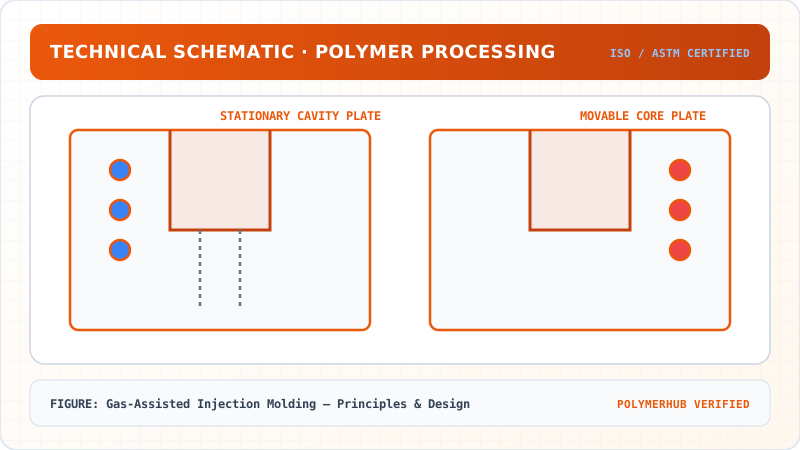
Gas-Assisted Injection Molding — Principles & Design — CAD Tooling & Machine Geometry Blueprint
Critical Geometric Dimensions & Tolerances (GD&T)
- Primary Processing Tolerance:± 0.02 mm (ISO 20457 Class M1)
- Thermal Expansion Allowance:1.5% (Volumetric Shrinkage)
- Draft Angle Minimum:1.0° - 1.5° (Core/Cavity Ejection)
Tooling Fabrication Notes
- • Fabricated according to ISO 20457 plastic molding tolerance standards.
- • EDM finish SPI C-1 applied across cavity optical contact faces.
- • Conformal cooling lines pressure tested at 12 bar water flow.
The Indian plastics industry is a significant global player, driven by strong growth in sectors like automotive, packaging, construction, and consumer goods. Gas-Assisted Injection Molding holds substantial relevance in this landscape:
- Automotive Sector: Major players like Maruti Suzuki, Tata Motors, and Mahindra & Mahindra are increasingly adopting GAIM for manufacturing lightweight vehicle components. This includes interior parts (dashboard panels, door handles, armrests), exterior components (spoilers, bumper reinforcements), and structural elements, all aimed at reducing vehicle weight to improve fuel efficiency and meet emission norms.
- Consumer Goods & Furniture: Companies such as Supreme Industries, Nilkamal, and Cello use GAIM to produce durable, lightweight, and aesthetically superior furniture (chairs, tables), storage solutions, and home appliances. The ability to create hollow, rigid structures without sink marks is highly valued here.
- Packaging Industry: While less prevalent than in other sectors, GAIM finds niche applications in packaging requiring high stiffness-to-weight ratios or specific aesthetic demands, potentially for premium or specialty containers.
- Skill Development & R&D: Institutions like the Central Institute of Plastics Engineering & Technology (CIPET), with its numerous centers across India, play a critical role in training manpower and conducting R&D in advanced processing technologies like GAIM. They often house modern GAIM machinery for demonstration and research, contributing to skill enhancement for the Indian plastics workforce.
- Tooling Industry: India has a robust mold and die-making industry, particularly in clusters like Ahmedabad, Pune, Chennai, and Mumbai. These toolmakers are increasingly tasked with designing and manufacturing sophisticated molds compatible with GAIM, requiring specialized expertise in gas channel design, pin placement, and hot runner systems.
- Material Suppliers: Companies like Reliance Industries, GAIL (India) Ltd., and Finolex, as major suppliers of polymer raw materials, indirectly support the growth of advanced processing techniques by ensuring the availability of suitable grades of polypropylene, ABS, polyamides, and other engineering plastics.
- MSME Sector: A large number of Micro, Small, and Medium Enterprises (MSMEs) in polymer processing clusters (e.g., Silvassa, Daman, Bhiwadi, Pune) are exploring or adopting GAIM for specialized product lines to gain a competitive edge in domestic and international markets, particularly for components requiring precision and aesthetic appeal.
- Sustainability Imperative: With growing environmental awareness and regulatory pressures, GAIM's ability to reduce material consumption aligns well with India's push towards sustainable manufacturing practices and a circular economy.
6. Standard Operating Procedures & Standards
While specific standards directly for the GAIM process parameters might be proprietary or industry-specific, several national and international standards are highly relevant to the materials, equipment, and characterization of parts produced using GAIM:
- ISO 294 Series (Plastics — Injection moulding of test specimens):
- ISO 294-1:2017: General principles and requirements for injection moulding of thermoplastic test specimens. While GAIM is a variation, the general principles of molding and specimen preparation are applicable for characterization.
- ISO 17290 (Injection moulds):
- This series provides general guidance on the design, construction, and testing of injection molds, including considerations for auxiliary features like gas injection systems.
- ASTM D790 (Standard Test Methods for Flexural Properties of Unreinforced and Reinforced Plastics and Electrical Insulating Materials):
- GAIM parts, with their hollow sections and optimized structure, often exhibit improved flexural rigidity. This standard is crucial for evaluating such mechanical enhancements.
- ASTM D638 (Standard Test Method for Tensile Properties of Plastics):
- Used to determine the tensile strength and elongation of the polymer material, which can be influenced by the cooling rate and internal structure created by GAIM.
- ASTM D256 (Standard Test Methods for Determining the Izod Pendulum Impact Resistance of Plastics):
- Impact strength is a critical property, especially for automotive and consumer goods parts, and is affected by processing conditions and part geometry.
- BIS (Bureau of Indian Standards):
- IS 7338:1995 (Polypropylene, moulding and extrusion materials): Relevant for the raw material if polypropylene is used in GAIM.
- IS 10901:2009 (Acrylonitrile butadiene styrene (ABS) moulding and extrusion materials): Relevant if ABS is used.
- BIS standards for specific products: For example, standards for plastic furniture, automotive components, or electrical enclosures, which GAIM-produced parts must conform to.
- Safety Standards:
- Standards related to the handling of high-pressure gases (like nitrogen) and the safe operation of injection molding machinery are paramount. These typically fall under national occupational safety and health regulations (e.g., OSHA equivalents in India's Factories Act) and manufacturer-specific safety protocols.
7. Key Takeaways & Glossary
Key Takeaways:
- Enhanced Part Quality & Design Flexibility: GAIM significantly improves part aesthetics by eliminating sink marks and reducing warpage, while enabling the creation of complex hollow structures and parts with widely varying wall thicknesses not possible with conventional injection molding.
- Material and Cost Efficiency: By creating hollow cores, GAIM leads to substantial material savings, reduced part weight, and often shorter cycle times due to faster cooling of thinner effective sections, resulting in significant production cost reductions.
- Process Control & Optimization: Effective implementation of GAIM requires precise control over polymer shot size, gas injection pressure and delay time, and careful design of gas channels and pin locations to achieve desired hollow part geometries and mechanical properties.
Glossary:
- Gas Pin: A specialized nozzle or valve located in the mold cavity through which high-pressure inert gas (typically nitrogen) is injected into the molten polymer to create a hollow core or assist in packing.
- Short Shot: A Gas-Assisted Injection Molding strategy where the mold cavity is intentionally filled with a partial volume of molten polymer, followed by the injection of gas to push the polymer to fill the remainder of the cavity and create the internal hollow.
- Sink Mark: A localized depression or indentation on the surface of an injection molded part, typically occurring in thicker sections, caused by volumetric shrinkage of the polymer during cooling and insufficient packing pressure.
8. Exam & Interview Practice Questions
1. GATE-style Multiple Choice Question: Which of the following is NOT a primary advantage of Gas-Assisted Injection Molding (GAIM) over conventional injection molding? A) Elimination of sink marks and reduced warpage. B) Production of solid, highly dense parts for high-stress applications. C) Significant material savings and reduced part weight. D) Shorter cycle times due to improved cooling efficiency.
Correct Answer: B Explanation: GAIM's core principle involves creating hollow sections, which inherently leads to lower density and lighter parts, making option B contrary to its primary advantages. It excels in improving quality and efficiency for parts that benefit from hollow structures.
2. Numerical Question with Step-by-Step Solution: A polymer component for an automotive application requires a 30% reduction in mass. Its solid volume is 400 cm³, and the polymer density is 1.1 g/cm³. If GAIM is used to achieve this mass reduction, and the gas injection pressure is maintained for 15 seconds, replacing 25 seconds of conventional hydraulic packing, calculate the mass of polymer saved per part and the potential packing time saved per 1000 parts.
Solution Step:
Solution: Given: Solid volume () = 400 cm³ Polymer density () = 1.1 g/cm³ Target mass reduction = 30% GAIM gas injection time = 15 s Conventional hydraulic packing time = 25 s
Step 1: Calculate the total mass of the solid part. Mass of solid part () =
Step 2: Calculate the mass saved per part. Mass saved () = 30% of
Step 3: Calculate the packing time saved per part. Packing time saved per part = Conventional packing time - GAIM gas injection time Packing time saved per part =
Step 4: Calculate the total packing time saved per 1000 parts. Total packing time saved = Total packing time saved = (Converting to hours: )
Final Answer: Mass of polymer saved per part: 132 g Potential packing time saved per 1000 parts: 10000 seconds (or approximately 2.78 hours)
3. Conceptual University Exam Question: Elaborate on the different nitrogen injection strategies employed in Gas-Assisted Injection Molding (GAIM). Discuss their respective advantages and disadvantages, and explain how the choice of strategy impacts mold design, gas channel configuration, and the final mechanical and aesthetic properties of the molded part.
Gas-Assisted Injection Molding — Principles & Design · Engineering Triad
Material Synthesis · Processing Hardware · Commercial Application
Polypropylene Homopolymer (PP-H)
—[CH₂—CH(CH₃)]ₙ— (Isotactic, PDI ~ 3.5–5.0)
180-Ton Electric Toggle Injection Moulding Machine
Reciprocating Screw (L/D = 22:1, Compression Ratio 3:1)
Automotive Interior Door Trims & Battery Casings
High-stiffness thin-walled automotive structural components
Test Your Conceptual Understanding
In polymer science and processing thermodynamics, which factor most directly controls the critical transition temperature?
- Always evaluate molecular weight distribution (MWD) alongside zero-shear viscosity when calculating mold shear rates.
- Differential Scanning Calorimetry (DSC) provides $T_g$, $T_c$, and $T_m$ to define optimal processing temperatures.
- Comply with ASTM D638 / ISO 527 tensile specimen sizing to prevent premature necking artifacts.
Personal Lesson Notes
Please sign in to write and save notes during lessons