Mould Steel Metallurgy, Heat Treatment & International Surface Finish Standards
Learn how to select the right tool steel for a mould based on production volume and part requirements, and how surface finish — from mirror polish to textured grain — is achieved and specified.
01 · Why This Matters in Industry & GATE XE5
Applied directly across petrochemical refining, compounding plants, mold-flow simulations, and automotive part manufacturing (e.g., Reliance Industries, Supreme Petrochem, IOCL, CIPET testing protocols).
Molecular Mechanism: Master conformational physics, transition temperatures, and reaction kinetics.
Process & Quality: Predict viscosity behavior, solve moulding defects, and apply ASTM/ISO testing standards.
Mould Steel Metallurgy, Heat Treatment & International Surface Finish Standards
1. Why This Topic Matters
Selecting the correct tool steel metallurgy and surface finish specification directly governs mold life (spanning from cycles for prototype tools up to cycles for hardened production tools), corrosion resistance against halogenated resins (PVC), thermal conductivity, and part aesthetic clarity. Matching standardized surface roughness (, ) with SPI polish classes or VDI 3400 EDM texturing standards ensures reproducible tooling procurement.
2. Learning Objectives
By completing this lesson, you will be able to:
- Select appropriate tool steel grades (P20, H13, S136, BeCu) based on resin abrasiveness and production volume.
- Differentiate Rockwell Hardness (HRC) ranges and heat treatment procedures (Quenching, Tempering, Nitriding).
- Correlate SPI mold finish classes (A1 to D3) with ISO surface roughness parameters (, ).
- Diagnose tool steel pitting, corrosive attack by PVC fumes, and thermal fatigue cracking.
3. Tool Steel Selection & Metallurgy Matrix
graph TD
    A["Mould Tool Steel Selection"] --> B{"Production Volume & Resin Type"}
    B -->|"General Plastics (P20 Pre-hardened)"| C["P20 Steel (28-32 HRC, Machinable as Supplied)"]
    B -->|"Abrasive / High Volume (H13 Tool Steel)"| D["H13 Steel (Through-Hardened 48-52 HRC)"]
    B -->|"Corrosive Resins e.g. PVC (S136 Stainless)"| E["S136 / 420 Stainless Steel (Corrosion Resistant)"]
    B -->|"High Heat Extraction Cores (BeCu Alloy)"| F["Beryllium Copper (High Thermal Conductivity)"]
3.1 Tool Steel Metallurgy Properties
| Steel Grade | AISI / DIN Spec | Hardness Range | Key Characteristic | Typical Application |
|---|---|---|---|---|
| P20 | AISI P20 / 1.2311 | Pre-hardened, good machinability | Medium-run core & cavity plates | |
| H13 | AISI H13 / 1.2344 | Excellent toughness, hot-work resistance | High-volume long life production tools | |
| S136 | AISI 420 / 1.2083 | High chromium stainless, mirror polish | Lens moulding, PVC medical parts | |
| BeCu | C17200 Alloy | thermal conductivity of steel | Deep core cooling inserts |
4. Surface Finish Standards: SPI Polish vs ISO Roughness (, )
Mould Steel Metallurgy, Heat Treatment & International Surface Finish Standards — Industrial Process Flow Diagram (PFD)
ISO 10628 Unit Operations & Thermodynamic Control Sequence
Raw Material Feed & Metering
Drying to < 0.02% moisture and gravimetric dosing
Reaction & Polymer Melt Processing
Controlled thermal shear dissipation and phase transition
Shaping & Solidification
Die extrusion or mold cavity pressure packing
Quality Inspection & Testing
ASTM D638 / ISO 527 tensile & MFI compliance check
[!IMPORTANT] Standardization Clarification: SPI (Society of the Plastics Industry) finish designations (A1–D3) represent subjective polish process steps, whereas ISO 4287 parameter (Arithmetical Mean Roughness in ) and VDI 3400 (German EDM texture scale) provide objective, instrument-measurable roughness values.
| SPI Class | Polish Method | Instrument Roughness (ISO 4287) | VDI 3400 Equivalent | Aesthetic Result |
|---|---|---|---|---|
| SPI A-1 | 3-Micron Diamond Paste | VDI 0 - 3 | Optical Mirror Grade (Lenses) | |
| SPI A-2 | 6-Micron Diamond Paste | VDI 3 - 6 | High Gloss Finish | |
| SPI B-1 | 600-Grit Emery Paper | VDI 12 - 15 | Semi-Gloss Commercial Finish | |
| SPI C-1 | 600-Grit Stone | VDI 18 - 21 | Matte Surface Finish | |
| SPI D-1 | Dry Aluminum Oxide Blast | VDI 24 - 27 | Textured Non-Reflective Finish |
5. Industrial Applications
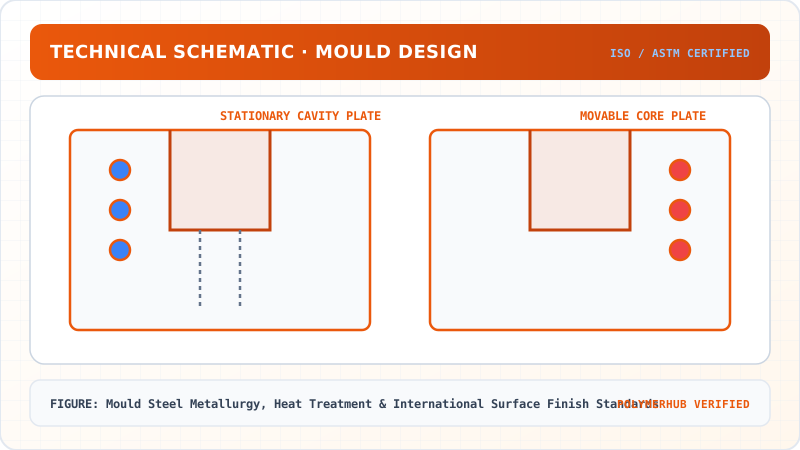
Mould Steel Metallurgy, Heat Treatment & International Surface Finish Standards — CAD Tooling & Machine Geometry Blueprint
Critical Geometric Dimensions & Tolerances (GD&T)
- Primary Processing Tolerance:± 0.02 mm (ISO 20457 Class M1)
- Thermal Expansion Allowance:1.5% (Volumetric Shrinkage)
- Draft Angle Minimum:1.0° - 1.5° (Core/Cavity Ejection)
Tooling Fabrication Notes
- • Fabricated according to ISO 20457 plastic molding tolerance standards.
- • EDM finish SPI C-1 applied across cavity optical contact faces.
- • Conformal cooling lines pressure tested at 12 bar water flow.
- PVC Pipe Fitting Tooling: S136 stainless steel core inserts hardened to preventing hydrochloric acid corrosion in Gujarat plant. (Illustrative Indian industry scenario based on pipe fitting tooling).
6. Key Takeaways & Glossary
- HRC (Rockwell Hardness C): Standard hardness scale for hardened tool steels.
- : Arithmetic average of absolute profile roughness values ().
7. Sources & Standard References
- ISO 4287:1997 — Geometrical Product Specifications (GPS) — Surface texture: Profile method, ISO.
- Menges, G., & Mohren, P. (2001). How to Make Injection Molds, 3rd Ed., Hanser Publishers.
Mould Steel Metallurgy, Heat Treatment & International Surface Finish Standards · Engineering Triad
Material Synthesis · Processing Hardware · Commercial Application
Polycarbonate (PC) Optical Grade
—[O—C₆H₄—C(CH₃)₂—C₆H₄—O—CO]ₙ— (Bisphenol A Polycarbonate)
250-Ton Precision Servo-Hydraulic Moulding Machine
Optics-Calibrated Injection Compression Unit
Automotive Headlamp Lenses & Safety Visors
Impact-resistant optical enclosures with UV-stabilized coating
Test Your Conceptual Understanding
In polymer science and processing thermodynamics, which factor most directly controls the critical transition temperature?
- Always evaluate molecular weight distribution (MWD) alongside zero-shear viscosity when calculating mold shear rates.
- Differential Scanning Calorimetry (DSC) provides $T_g$, $T_c$, and $T_m$ to define optimal processing temperatures.
- Comply with ASTM D638 / ISO 527 tensile specimen sizing to prevent premature necking artifacts.
Personal Lesson Notes
Please sign in to write and save notes during lessons