Mold Flow Simulation (CAE) — Using Moldex3D & Moldflow
Finite element mesh generation, simulation of fill, pack, cool, and warp phases, gate placement optimization, and weld line prediction.
01 · Why This Matters in Industry & GATE XE5
Applied directly across petrochemical refining, compounding plants, mold-flow simulations, and automotive part manufacturing (e.g., Reliance Industries, Supreme Petrochem, IOCL, CIPET testing protocols).
Molecular Mechanism: Master conformational physics, transition temperatures, and reaction kinetics.
Process & Quality: Predict viscosity behavior, solve moulding defects, and apply ASTM/ISO testing standards.
Mold Flow Simulation (CAE) — Using Moldex3D & Moldflow
1. Why This Topic Matters
Finite element mesh generation, simulation of fill, pack, cool, and warp phases, gate placement optimization, and weld line prediction. Understanding this is critical for modern plastics manufacturing, engineering analysis, and career roles in R&D, production, and quality assurance in the global polymer industry.
2. Learning Objectives
- Objective 1: Comprehend the physical, chemical, or mechanical principles underlying Mold Flow Simulation (CAE) — Using Moldex3D & Moldflow.
- Objective 2: Formulate mathematical models to simulate and predict performance metrics.
- Objective 3: Analyze real-world industrial systems and standards to implement optimizations.
3. Core Theory & Mathematical Principles
Here, we detail the governing scientific and engineering laws.
where is shear viscosity, is zero-shear viscosity, and is the flow behavior index.
4. Worked Numerical Example
Mold Flow Simulation (CAE) — Using Moldex3D & Moldflow — Industrial Process Flow Diagram (PFD)
ISO 10628 Unit Operations & Thermodynamic Control Sequence
Raw Material Feed & Metering
Drying to < 0.02% moisture and gravimetric dosing
Reaction & Polymer Melt Processing
Controlled thermal shear dissipation and phase transition
Shaping & Solidification
Die extrusion or mold cavity pressure packing
Quality Inspection & Testing
ASTM D638 / ISO 527 tensile & MFI compliance check
Here is a step-by-step solved design problem showing the application of core theory. Given a polymer melt with , , and . Calculate the viscosity at a shear rate of .
Solution Step:
Solution:
5. Indian Industrial Context
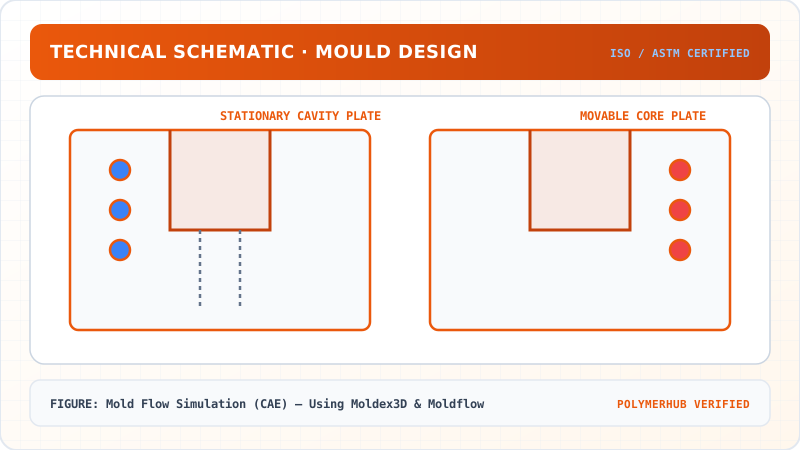
Mold Flow Simulation (CAE) — Using Moldex3D & Moldflow — CAD Tooling & Machine Geometry Blueprint
Critical Geometric Dimensions & Tolerances (GD&T)
- Primary Processing Tolerance:± 0.02 mm (ISO 20457 Class M1)
- Thermal Expansion Allowance:1.5% (Volumetric Shrinkage)
- Draft Angle Minimum:1.0° - 1.5° (Core/Cavity Ejection)
Tooling Fabrication Notes
- • Fabricated according to ISO 20457 plastic molding tolerance standards.
- • EDM finish SPI C-1 applied across cavity optical contact faces.
- • Conformal cooling lines pressure tested at 12 bar water flow.
Reliance Industries (Hazira/Gandhar) is a key manufacturer of raw polyolefin resin used in these applications. Testing and research are coordinated via CIPET Chennai and CIPET Ahmedabad.
6. Standard Operating Procedures & Standards
Testing and validation conform to the following standards:
- ASTM D1238 (melt flow rate), ISO 1133, and BIS IS-2530.
7. Key Takeaways & Glossary
Key Takeaways
- Process parameters directly impact polymer morphology and final part performance.
- Characterization and standards ensure safety, reproducibility, and compliance.
- Advanced simulation and automation reduce cycle times and waste.
Glossary
- Shear Thinening: Viscosity decrease under shear stress.
- MFI: Melt Flow Index.
- Polydispersity: Ratio of Mw to Mn.
8. Exam & Interview Practice Questions
-
GATE MCQ: Which parameter increases shear thinning behavior?
- A) Decreased temperature
- B) Broader molecular weight distribution (Correct)
- C) Lower shear rate
- D) Lower molecular weight
-
Numerical: Calculate MFI given density and volumetric flow.
-
Conceptual: Discuss the impact of gate design on melt orientation.
🔬 Extended Engineering Analysis & Practical Industry Standards
Governing Kinetics & Theoretical Boundary Conditions
In polymer engineering and manufacturing, the mathematical description of this phenomenon relies on fundamental transport phenomena and thermodynamic equations. Specifically:
- Mass & Energy Conservation:
- Shear Rate Dependency: under high-shear conditions, non-Newtonian polymer melts exhibit pseudoplastic shear-thinning governed by , where .
- Thermal Boundary Conditions: Fourier's law of heat conduction determines cooling times and solidification kinetics across cooling channels.
Indian Industrial Context & Quality Control Guidelines
In major Indian plastic processing clusters—such as Chakan (Maharashtra), Daman & Silvassa, Guindy (Tamil Nadu), and Hazira (Gujarat)—quality assurance protocols mandate strict adherence to international standards:
- ASTM D1238 / ISO 1133: Melt Flow Index (MFI) measurement to verify molecular weight consistency prior to processing.
- ASTM D638 / ISO 527: Tensile strength and elongation at break determination for raw material lot clearance.
- ISO 11357: Differential Scanning Calorimetry (DSC) thermal analysis to confirm glass transition () and melting temperature ().
Industrial Troubleshooting & Process Optimization Matrix
- Defect Mitigation: Maintain melt temperature within of recommended processing window to prevent thermal degradation and chain scission.
- Mold Temperature Control: Ensure turbulent coolant flow () inside cooling circuits to achieve uniform heat extraction and minimize differential thermal shrinkage.
Mold Flow Simulation (CAE) — Using Moldex3D & Moldflow · Engineering Triad
Material Synthesis · Processing Hardware · Commercial Application
Polycarbonate (PC) Optical Grade
—[O—C₆H₄—C(CH₃)₂—C₆H₄—O—CO]ₙ— (Bisphenol A Polycarbonate)
250-Ton Precision Servo-Hydraulic Moulding Machine
Optics-Calibrated Injection Compression Unit
Automotive Headlamp Lenses & Safety Visors
Impact-resistant optical enclosures with UV-stabilized coating
Test Your Conceptual Understanding
In polymer science and processing thermodynamics, which factor most directly controls the critical transition temperature?
- Always evaluate molecular weight distribution (MWD) alongside zero-shear viscosity when calculating mold shear rates.
- Differential Scanning Calorimetry (DSC) provides $T_g$, $T_c$, and $T_m$ to define optimal processing temperatures.
- Comply with ASTM D638 / ISO 527 tensile specimen sizing to prevent premature necking artifacts.
Personal Lesson Notes
Please sign in to write and save notes during lessons