Thermoplastics vs Thermosets: Molecular Structure, Thermal Transitions & Recyclability
Learn the fundamental chemical difference between thermoplastics and thermosets — why one can be melted and reshaped endlessly while the other cannot — and how this drives material selection in industry.
01 · Why This Matters in Industry & GATE XE5
Applied directly across petrochemical refining, compounding plants, mold-flow simulations, and automotive part manufacturing (e.g., Reliance Industries, Supreme Petrochem, IOCL, CIPET testing protocols).
Molecular Mechanism: Master conformational physics, transition temperatures, and reaction kinetics.
Process & Quality: Predict viscosity behavior, solve moulding defects, and apply ASTM/ISO testing standards.
Thermoplastics vs Thermosets: Molecular Structure, Thermal Transitions & Recyclability
1. Why This Topic Matters
Polymers are fundamentally categorized by their response to heat and molecular architecture into Thermoplastics (linear or branched chains held by weak van der Waals forces) and Thermosets (3D covalently crosslinked networks). Understanding this distinction governs manufacturing process selection (injection moulding vs compression curing), thermal service limits, glass transition () versus degradation temperature (), and circular economy recycling pathways.
2. Learning Objectives
By completing this lesson, you will be able to:
- Correlate molecular chain architecture (linear/branched vs crosslinked) with mechanical response.
- Differentiate glass transition (), melting point (), and thermal degradation ().
- Explain mechanical melt re-processability vs chemical/solvolysis recycling of crosslinked networks.
- Diagnose thermal degradation in overheated thermoset and thermoplastic resins.
3. Core Theory & Structural Comparison
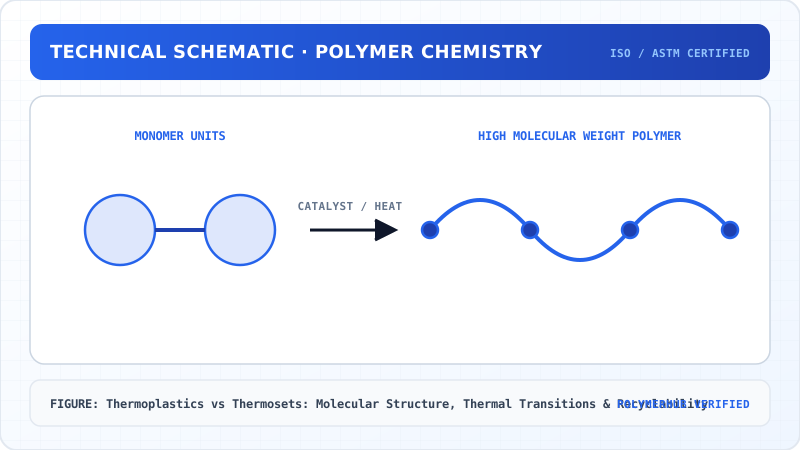
Thermal homolytic cleavage of initiator followed by monomer radical addition.
Rapid successive head-to-tail monomer addition to propagating macroradicals.
Bimolecular mutual radical annihilation via combination or disproportionation.
graph TD
    A["Polymer Classification"] --> B["Thermoplastics (Linear / Branched)"]
    A --> C["Thermosets (3D Crosslinked Network)"]
    B --> D["Physical Reversible Melting at Tm (Re-processable)"]
    C --> E["Irreversible Curing / Chemical Degradation at Td (Non-meltable)"]
3.1 Thermal Transitions & Molecular Architecture
- Thermoplastics (e.g. PP, PE, PET, PA66): Amorphous regions undergo glass transition (); crystalline domains melt reversibly at . Interchain van der Waals forces break upon heating and reform upon cooling.
- Thermosets (e.g. Epoxy, Phenol-Formaldehyde, Unsaturated Polyester): Covalent crosslinks prevent chain sliding. Thermosets do not melt; heating past leads directly to irreversible thermal degradation () via covalent bond scission.
| Property Feature | Thermoplastics | Thermosets |
|---|---|---|
| Molecular Architecture | Linear or branched chains | 3D covalent crosslinked network |
| Interchain Bonding | Secondary van der Waals / Hydrogen bonds | Primary covalent crosslinks |
| Thermal Behavior | Softens/melts reversibly upon heating | Infusible; degrades at |
| Mechanical Recyclability | Re-meltable and re-extrudable | Cannot be re-melted mechanically |
| Solubility | Soluble in organic solvents | Swells but remains insoluble |
| Creep Resistance | Moderate to low at elevated temperature | Excellent creep resistance up to |
4. Recyclability Nuances: Mechanical vs Tertiary Solvolysis Recovery
Thermoplastics vs Thermosets: Molecular Structure, Thermal Transitions & Recyclability — Industrial Process Flow Diagram (PFD)
ISO 10628 Unit Operations & Thermodynamic Control Sequence
Raw Material Feed & Metering
Drying to < 0.02% moisture and gravimetric dosing
Reaction & Polymer Melt Processing
Controlled thermal shear dissipation and phase transition
Shaping & Solidification
Die extrusion or mold cavity pressure packing
Quality Inspection & Testing
ASTM D638 / ISO 527 tensile & MFI compliance check
[!IMPORTANT] Recyclability Clarification: While conventional permanently crosslinked thermosets cannot be re-melted mechanically like thermoplastics, they are not completely unrecyclable. Modern tertiary recovery pathways (such as acid-catalyzed solvolysis, pyrolysis, or mechanical grinding into filler) can recover composite fibers or chemical feedstocks. Advanced covalent adaptable networks (vitrimers) also introduce reversible crosslinking.
5. Industrial Applications
Thermoplastics vs Thermosets: Molecular Structure, Thermal Transitions & Recyclability — CAD Tooling & Machine Geometry Blueprint
Critical Geometric Dimensions & Tolerances (GD&T)
- Primary Processing Tolerance:± 0.02 mm (ISO 20457 Class M1)
- Thermal Expansion Allowance:1.5% (Volumetric Shrinkage)
- Draft Angle Minimum:1.0° - 1.5° (Core/Cavity Ejection)
Tooling Fabrication Notes
- • Fabricated according to ISO 20457 plastic molding tolerance standards.
- • EDM finish SPI C-1 applied across cavity optical contact faces.
- • Conformal cooling lines pressure tested at 12 bar water flow.
- Automotive Brake Pads & Switchgear: Phenolic resins (thermosets) for heat resistance. (Illustrative Indian industry scenario based on electrical switchgear manufacturing in Mumbai).
6. Key Takeaways & Glossary
- (Glass Transition Temperature): Temperature where amorphous polymer transitions from glassy state to rubbery state.
- Crosslink Density: Concentration of covalent chemical bonds joining polymer chains.
7. Sources & Standard References
- ISO 11357-1:2023 — Plastics — Differential scanning calorimetry (DSC) — Part 1: General principles, ISO.
- Sperling, L. H. (2006). Introduction to Physical Polymer Science, 4th Ed., Wiley-Interscience.
Thermoplastics vs Thermosets: Molecular Structure, Thermal Transitions & Recyclability · Engineering Triad
Material Synthesis · Processing Hardware · Commercial Application
High-Density Polyethylene (HDPE)
—[CH₂—CH₂]ₙ— (Linear, M_w ~ 120,000–250,000 g/mol)
Continuous Gas-Phase Fluidized Bed Reactor
Unipol / Hostalen Polymerization Technology
Extrusion Blow-Molded Fuel & Chemical Tanks
Automotive fuel containment & UN-certified hazardous chemical drums
Test Your Conceptual Understanding
In polymer science and processing thermodynamics, which factor most directly controls the critical transition temperature?
- Always evaluate molecular weight distribution (MWD) alongside zero-shear viscosity when calculating mold shear rates.
- Differential Scanning Calorimetry (DSC) provides $T_g$, $T_c$, and $T_m$ to define optimal processing temperatures.
- Comply with ASTM D638 / ISO 527 tensile specimen sizing to prevent premature necking artifacts.
Personal Lesson Notes
Please sign in to write and save notes during lessons