Crystallinity, Lamellar Morphology & Density Characterization in Polymers
Discover how polymer chains arrange themselves into ordered (crystalline) and disordered (amorphous) regions, and why this microscopic structure controls macroscopic properties like strength, clarity, and shrinkage.
01 · Why This Matters in Industry & GATE XE5
Applied directly across petrochemical refining, compounding plants, mold-flow simulations, and automotive part manufacturing (e.g., Reliance Industries, Supreme Petrochem, IOCL, CIPET testing protocols).
Molecular Mechanism: Master conformational physics, transition temperatures, and reaction kinetics.
Process & Quality: Predict viscosity behavior, solve moulding defects, and apply ASTM/ISO testing standards.
Crystallinity, Lamellar Morphology & Density Characterization in Polymers
1. Why This Topic Matters
Polymer morphology—the spatial arrangement of crystalline lamellae and amorphous domain chains—controls mechanical stiffness, barrier performance, optical clarity, and chemical resistance. Semi-crystalline polymers like HDPE, PP, and PET exhibit distinct melting temperatures () and spherulitic structures, whereas amorphous polymers like PS and PMMA exhibit only glass transition (). Measuring degree of crystallinity () is critical for qualifying raw resins and predicting shrinkage in moulded components.
2. Learning Objectives
By completing this lesson, you will be able to:
- Explain fringe-micelle vs folded-chain lamellar model and spherulite growth kinetics.
- Calculate percentage degree of crystallinity () from density gradient measurements and DSC enthalpy of fusion.
- Compare semi-crystalline vs amorphous polymer thermal and optical characteristics.
- Diagnose physical aging, post-moulding crystallization, and void formation.
3. Core Theory & Morphological Structure
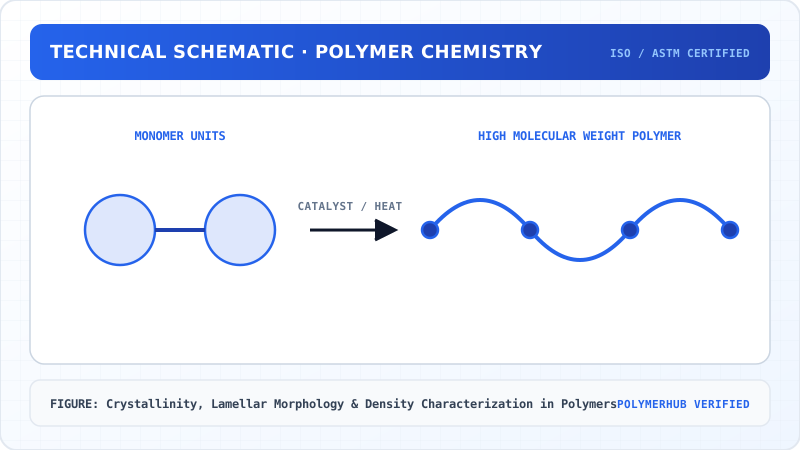
Thermal homolytic cleavage of initiator followed by monomer radical addition.
Rapid successive head-to-tail monomer addition to propagating macroradicals.
Bimolecular mutual radical annihilation via combination or disproportionation.
Spherulitic Morphology
Crystalline lamellae radiate outward from central nucleation sites, separated by amorphous tie-molecules, forming spherical structures called spherulites. Larger spherulites increase stiffness but reduce optical clarity and impact strength.
graph TD
    A["Polymer Melt at Temperature T > Tm"] --> B["Nucleation (Homogeneous / Heterogeneous)"]
    B --> C["Chain Folding & Lamellar Growth"]
    C --> D["Spherulite Radius Expansion with Amorphous Inter-Lamellar Domains"]
    D --> E["Solid Semi-Crystalline Polymer Structure"]
4. Equations & Recalculated Worked Example
Crystallinity, Lamellar Morphology & Density Characterization in Polymers — Industrial Process Flow Diagram (PFD)
ISO 10628 Unit Operations & Thermodynamic Control Sequence
Raw Material Feed & Metering
Drying to < 0.02% moisture and gravimetric dosing
Reaction & Polymer Melt Processing
Controlled thermal shear dissipation and phase transition
Shaping & Solidification
Die extrusion or mold cavity pressure packing
Quality Inspection & Testing
ASTM D638 / ISO 527 tensile & MFI compliance check
Density-Based Degree of Crystallinity Equation
The weight-fraction degree of crystallinity () derived from bulk density (), 100% amorphous density (), and 100% crystalline density () is:
Worked Numerical Example:
Problem Statement:
Problem: A Polypropylene (PP) moulded part has a measured bulk density . Known reference values for PP are amorphous density and crystalline unit cell density . Calculate the percentage degree of crystallinity ().
Solution Step:
Solution:
- Calculate numerator:
- Calculate denominator:
- Calculate :
Interpretation: The polypropylene sample possesses crystalline lamellae content by weight.
5. Industrial Applications
Crystallinity, Lamellar Morphology & Density Characterization in Polymers — CAD Tooling & Machine Geometry Blueprint
Critical Geometric Dimensions & Tolerances (GD&T)
- Primary Processing Tolerance:± 0.02 mm (ISO 20457 Class M1)
- Thermal Expansion Allowance:1.5% (Volumetric Shrinkage)
- Draft Angle Minimum:1.0° - 1.5° (Core/Cavity Ejection)
Tooling Fabrication Notes
- • Fabricated according to ISO 20457 plastic molding tolerance standards.
- • EDM finish SPI C-1 applied across cavity optical contact faces.
- • Conformal cooling lines pressure tested at 12 bar water flow.
- BOPP Film Clarity: Rapid chill-roll quenching to suppress spherulite growth for high-clarity packaging film. (Illustrative Indian industry scenario based on film line operations in Silvassa).
- PET Bottle Preforms: Mold cooling control to maintain amorphous transparency prior to stretch blow molding.
6. Key Takeaways & Glossary
- Spherulites: Spherical aggregates of crystalline lamellae separated by amorphous domains.
- Nucleating Agents: Additives providing heterogeneous sites for rapid, fine-grained crystallization.
- Lamella: Folded-chain crystalline ribbon (typically thick).
7. Sources & Standard References
- Wunderlich, B. (2005). Thermal Analysis of Polymeric Materials, Springer.
- ISO 11357-3:2018 — Plastics — Differential scanning calorimetry (DSC) — Part 3: Determination of temperature and enthalpy of melting and crystallization.
Crystallinity, Lamellar Morphology & Density Characterization in Polymers · Engineering Triad
Material Synthesis · Processing Hardware · Commercial Application
High-Density Polyethylene (HDPE)
—[CH₂—CH₂]ₙ— (Linear, M_w ~ 120,000–250,000 g/mol)
Continuous Gas-Phase Fluidized Bed Reactor
Unipol / Hostalen Polymerization Technology
Extrusion Blow-Molded Fuel & Chemical Tanks
Automotive fuel containment & UN-certified hazardous chemical drums
Test Your Conceptual Understanding
In polymer science and processing thermodynamics, which factor most directly controls the critical transition temperature?
- Always evaluate molecular weight distribution (MWD) alongside zero-shear viscosity when calculating mold shear rates.
- Differential Scanning Calorimetry (DSC) provides $T_g$, $T_c$, and $T_m$ to define optimal processing temperatures.
- Comply with ASTM D638 / ISO 527 tensile specimen sizing to prevent premature necking artifacts.
Personal Lesson Notes
Please sign in to write and save notes during lessons