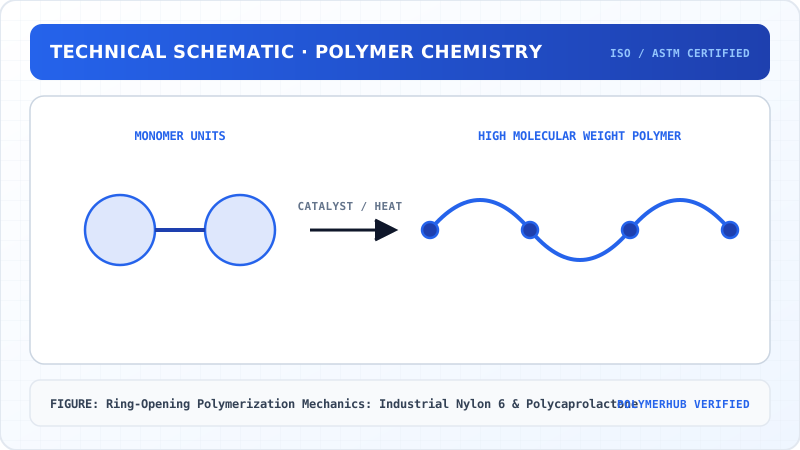
Ring-Opening Polymerization Mechanics: Industrial Nylon 6 & Polycaprolactone
Comprehensive treatment of thermodynamic equilibrium, hydrolytic vs anionic Nylon 6 ROP, and coordination-insertion Polycaprolactone synthesis.
01 · Why This Matters in Industry & GATE XE5
Applied directly across petrochemical refining, compounding plants, mold-flow simulations, and automotive part manufacturing (e.g., Reliance Industries, Supreme Petrochem, IOCL, CIPET testing protocols).
Molecular Mechanism: Master conformational physics, transition temperatures, and reaction kinetics.
Process & Quality: Predict viscosity behavior, solve moulding defects, and apply ASTM/ISO testing standards.
Ring-Opening Polymerization Mechanics: Industrial Nylon 6 & Polycaprolactone
1. Why This Topic Matters
Ring-Opening Polymerization (ROP) is the industrial method used to produce high-molecular-weight polymers from cyclic monomers, such as caprolactam (for Nylon 6) and -caprolactone (for Polycaprolactone). Unlike step-growth condensation, ROP avoids the formation of volatile by-products (like water), allowing rapid polymerisation rates and high molecular weights. In India, massive polymer complexes operated by firms like GSFC (Gujarat State Fertilizers & Chemicals) and SRF Limited use ROP of caprolactam to manufacture Nylon 6 engineering resins and tire cords.
2. Learning Objectives
- Explain the thermodynamic driving force for ROP based on ring strain (3 to 8-membered rings).
- Detail the cationic and anionic polymerization mechanisms of cyclic monomers.
- Describe the industrial production steps for Nylon 6 from -caprolactam using hydrolytic ROP.
- Calculate the molecular weight of polymers produced by ring-opening polymerization.
- Reference polymer chemistry standards and safety guidelines.
3. Core Theory
Thermal homolytic cleavage of initiator followed by monomer radical addition.
Rapid successive head-to-tail monomer addition to propagating macroradicals.
Bimolecular mutual radical annihilation via combination or disproportionation.
3.1 Thermodynamics of Ring-Opening
The polymerisation of a cyclic monomer is governed by the free energy change :
- Ring Strain: Drive for polymerization is release of ring strain. 3- and 4-membered rings have high strain (angular and steric) high thermodynamic drive.
- Caprolactam (7-membered): Moderate ring strain ( to kJ/mol), but polymerization is possible due to favorable thermodynamic conditions under heating.
3.2 Mechanisms of ROP
- Hydrolytic ROP (Industrial Nylon 6): Caprolactam is heated with water:
- Ring Opening: Water hydrolyzes caprolactam to -aminocaproic acid.
- Initiation: The amine end-group nucleophilically attacks caprolactam rings, opening them.
- Propagation: Amine ends continue to add caprolactam monomers continuously.
- Anionic ROP: Uses strong bases (e.g., sodium caprolactam) and acyl lactam initiators. Fast kinetics, completed in minutes (used in reaction injection moulding, RIM).
3.3 Polycaprolactone (PCL) Synthesis
PCL is a biodegradable polyester produced by ROP of -caprolactone using tin(II) octoate () catalyst and an alcohol initiator. Used in biomedical implants and drug delivery due to low (60°C) and excellent biocompatibility.
4. Worked Example
Ring-Opening Polymerization Mechanics: Industrial Nylon 6 & Polycaprolactone — Industrial Process Flow Diagram (PFD)
ISO 10628 Unit Operations & Thermodynamic Control Sequence
Raw Material Feed & Metering
Drying to < 0.02% moisture and gravimetric dosing
Reaction & Polymer Melt Processing
Controlled thermal shear dissipation and phase transition
Shaping & Solidification
Die extrusion or mold cavity pressure packing
Quality Inspection & Testing
ASTM D638 / ISO 527 tensile & MFI compliance check
Problem Statement:
Problem: An anionic ROP of -caprolactam is conducted using sodium caprolactam initiator and an acetyl caprolactam activator. The initial monomer concentration is mol/L, and the activator concentration is mol/L. Assuming complete conversion of the monomer, calculate the theoretical number-average molecular weight () of the Nylon 6 polymer. (Caprolactam monomer MW = 113.16 g/mol).
Solution Step:
Solution: In active ROP with an activator, each activator molecule initiates one polymer chain:
Calculate the number-average molecular weight :
Interpretation: The ROP yields a Nylon 6 polymer with g/mol, which falls within the range for fiber-spinning applications. By adjusting the monomer-to-activator ratio, operators can tailor the polymer viscosity.
5. Indian Industry Context
Ring-Opening Polymerization Mechanics: Industrial Nylon 6 & Polycaprolactone — CAD Tooling & Machine Geometry Blueprint
Critical Geometric Dimensions & Tolerances (GD&T)
- Primary Processing Tolerance:± 0.02 mm (ISO 20457 Class M1)
- Thermal Expansion Allowance:1.5% (Volumetric Shrinkage)
- Draft Angle Minimum:1.0° - 1.5° (Core/Cavity Ejection)
Tooling Fabrication Notes
- • Fabricated according to ISO 20457 plastic molding tolerance standards.
- • EDM finish SPI C-1 applied across cavity optical contact faces.
- • Conformal cooling lines pressure tested at 12 bar water flow.
Gujarat State Fertilizers & Chemicals (GSFC) (Vadodara) is India's largest producer of caprolactam and Nylon 6 (under the brand name Gujlon). Their continuous polymerization lines utilize hydrolytic ROP to supply engineering grades to domestic injection moulders for automotive under-the-hood applications.
SRF Limited (Chennai) polymerizes caprolactam to manufacture high-tenacity Nylon 6 tire cord fabrics, a critical reinforcement material for heavy vehicle tires.
6. Key Takeaways & Glossary
- Caprolactam: 7-membered cyclic amide monomer used to produce Nylon 6.
- ROP: Ring-Opening Polymerization; chain-growth mechanism transforming cyclic monomers into acyclic polymers.
- Hydrolytic Polymerization: The standard industrial pathway for Nylon 6 using water to open the initial monomer rings.
- Tin(II) Octoate: Standard FDA-approved catalyst used to synthesize bio-compatible polyesters like PCL.
- Maturation: (Not applicable, SMC/rubber term).
7. Standards Reference
- ISO 307 — Plastics — Polyamides — Determination of viscosity number (used to qualify Nylon 6 MW)
- ASTM D4066 — Standard Classification System for Nylon Injection and Extrusion Materials
- IS 4867 — Indian Standard specifications for polyamide (Nylon 6) molding materials
8. Practice Questions
- Explain the step-by-step reaction mechanism of hydrolytic ROP of caprolactam, showing the ring-opening, step-growth, and chain-growth propagation reactions.
- Why is anionic ROP of caprolactam much faster than hydrolytic ROP? Compare their processing applications.
- Discuss the ring-strain thermodynamics of 3, 5, 6, and 7-membered cyclic ethers. Why does cyclohexene oxide polymerize whereas cyclopentene oxide is difficult?
Ring-Opening Polymerization Mechanics: Industrial Nylon 6 & Polycaprolactone · Engineering Triad
Material Synthesis · Processing Hardware · Commercial Application
High-Density Polyethylene (HDPE)
—[CH₂—CH₂]ₙ— (Linear, M_w ~ 120,000–250,000 g/mol)
Continuous Gas-Phase Fluidized Bed Reactor
Unipol / Hostalen Polymerization Technology
Extrusion Blow-Molded Fuel & Chemical Tanks
Automotive fuel containment & UN-certified hazardous chemical drums
Test Your Conceptual Understanding
In polymer science and processing thermodynamics, which factor most directly controls the critical transition temperature?
- Always evaluate molecular weight distribution (MWD) alongside zero-shear viscosity when calculating mold shear rates.
- Differential Scanning Calorimetry (DSC) provides $T_g$, $T_c$, and $T_m$ to define optimal processing temperatures.
- Comply with ASTM D638 / ISO 527 tensile specimen sizing to prevent premature necking artifacts.
Personal Lesson Notes
Please sign in to write and save notes during lessons