Mechanical Recycling: Collection, Sorting & Extrusion Reprocessing Kinetics
Master the mechanical recycling process from post-consumer collection through washing, sorting, shredding, and pelletizing — the backbone of India's current recycling infrastructure.
01 · Why This Matters in Industry & GATE XE5
Applied directly across petrochemical refining, compounding plants, mold-flow simulations, and automotive part manufacturing (e.g., Reliance Industries, Supreme Petrochem, IOCL, CIPET testing protocols).
Molecular Mechanism: Master conformational physics, transition temperatures, and reaction kinetics.
Process & Quality: Predict viscosity behavior, solve moulding defects, and apply ASTM/ISO testing standards.
Mechanical Recycling: Collection, Sorting & Extrusion Reprocessing Kinetics
1. Why This Topic Matters
Mechanical recycling is the most widely implemented circular economy pathway for plastics, converting post-consumer waste back into reusable pellets. However, sorting efficiency and thermal degradation during reprocessing limit the quality of recycled resins. Recycled resins undergo chain scission and oxidation, lowering their melt flow index and mechanical properties. Indian recycling firms like Ganesha Ecosphere and Srichakra Polyplast optimize collection, automated sorting, and compounding extrusion to supply high-quality PCR resins to FMCG brands.
2. Learning Objectives
- Map the steps of mechanical recycling (collection, washing, density separation, compounding extrusion).
- Explain the working principles of automated sorting technologies (Near-Infrared spectroscopy).
- Analyze the thermal degradation kinetics (chain scission vs. crosslinking) of polymers during extrusion.
- Calculate sorting purity and recovery efficiency from sorting mass balance data.
- Reference international plastics recycling standards including ISO 15270.
3. Core Theory
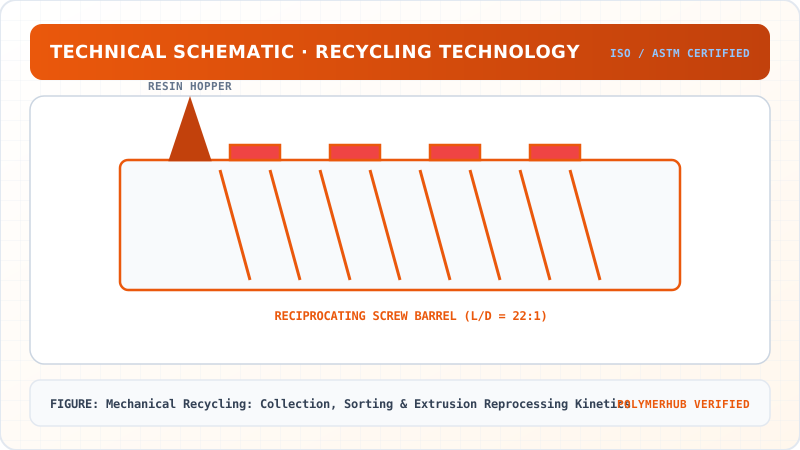
3.1 Steps in Mechanical Recycling
- Collection & Baling: Consolidation of post-consumer plastic waste.
- Sorting: Separating polymers by type (PET, HDPE, PP, LDPE) and color.
- Shredding & Washing: Size reduction to flakes, followed by hot washing (with NaOH and surfactants) to remove adhesives and labels.
- Density Separation (Sink-Float): Separating polymers by density in water:
- Polyolefins (PE, PP, density g/cm³) float.
- PET and PVC (density g/cm³) sink.
- Reprocessing & Compounding: Extruding flakes with vacuum venting and melt filtration to produce pellets.
3.2 Automated Sorting (NIR Spectroscopy)
Near-Infrared (NIR) sensors identify polymers by analyzing the reflected spectrum ( nm) corresponding to CH, OH, and NH vibrational overtones. Air jets blow the identified items into collection bins. NIR cannot identify black plastics (carbon black absorbs all NIR light).
3.3 Reprocessing degradation kinetics
Repeated extrusion passes subject the polymer to high temperature and shear stress, driving degradation:
- Chain Scission (e.g., PP): Homolytic cleavage of carbon-carbon bonds, generating shorter chains viscosity drops, MFI increases.
- Crosslinking (e.g., PE): Free radical reactions lead to chain branching and gel formation viscosity rises, MFI decreases. Antioxidants must be added during recycling to prevent this degradation.
4. Worked Example
Mechanical Recycling: Collection, Sorting & Extrusion Reprocessing Kinetics — Industrial Process Flow Diagram (PFD)
ISO 10628 Unit Operations & Thermodynamic Control Sequence
Raw Material Feed & Metering
Drying to < 0.02% moisture and gravimetric dosing
Reaction & Polymer Melt Processing
Controlled thermal shear dissipation and phase transition
Shaping & Solidification
Die extrusion or mold cavity pressure packing
Quality Inspection & Testing
ASTM D638 / ISO 527 tensile & MFI compliance check
Problem Statement:
Problem: A recycling sorting facility processes a bale of mixed bottles containing PET and PVC. An automated optical sorter is configured to eject PVC bottles. The data is:
- Input mass feed rate = kg/h.
- Mass fraction of PVC in the feed = .
- Output stream from the sorter (Ejected Bin) = kg/h, containing kg/h of PVC and kg/h of misplaced PET. Calculate:
- The mass flow rate of PVC entering the sorter.
- The PVC sorting recovery efficiency (%).
- The PVC sorting purity (%) of the ejected stream.
Solution Step:
Solution:
- Calculate incoming PVC mass rate:
- Calculate PVC sorting recovery efficiency:
- Calculate PVC purity of the ejected stream:
Interpretation: The optical sorter successfully recovers 86.11% of the PVC in the stream with a purity of 93.94%. The remaining 13.89% PVC remains in the PET stream, representing a contamination risk since PVC degrades at PET processing temperatures (releasing HCl, which degrades the machinery and PET polymer).
5. Indian Industry Context
Mechanical Recycling: Collection, Sorting & Extrusion Reprocessing Kinetics — CAD Tooling & Machine Geometry Blueprint
Critical Geometric Dimensions & Tolerances (GD&T)
- Primary Processing Tolerance:± 0.02 mm (ISO 20457 Class M1)
- Thermal Expansion Allowance:1.5% (Volumetric Shrinkage)
- Draft Angle Minimum:1.0° - 1.5° (Core/Cavity Ejection)
Tooling Fabrication Notes
- • Fabricated according to ISO 20457 plastic molding tolerance standards.
- • EDM finish SPI C-1 applied across cavity optical contact faces.
- • Conformal cooling lines pressure tested at 12 bar water flow.
Ganesha Ecosphere Limited (Kanpur) is India's largest recycler of PET bottles, converting post-consumer waste into recycled polyester staple fiber (rPSF) and food-grade rPET pellets. They utilize sink-float density separation to remove PP caps and PE labels from sinking PET bottle flakes.
Srichakra Polyplast (Hyderabad) operates automated sorting lines equipped with Tomra NIR sorters to supply high-purity recycled HDPE and PP to FMCG clients like Unilever and Coca-Cola, satisfying EPR plastic reuse mandates.
6. Key Takeaways & Glossary
- Mechanical Recycling: Physical reprocessing of plastic waste into pellets without modifying chemical structures.
- NIR Sorter: Automated sorting tool utilizing near-infrared spectroscopy to separate polymers.
- Sink-Float: Density-based fluid separation technique separating polyolefins ( g/cm³) from heavy plastics.
- Chain Scission: Polymer degradation mechanism reducing molecular weight and viscosity.
- Z\eta Potential: (Not applicable, latex parameter).
7. Standards Reference
- ISO 15270 — Plastics — Guidelines for the recovery and recycling of plastics waste
- ASTM D7611 — Standard Practice for Coding Plastic Manufactured Articles for Recycling
- IS 14534 — Bureau of Indian Standards (BIS) guidelines for recycling of plastics
8. Practice Questions
- Explain the molecular degradation reactions that occur during the extrusion of recycled polypropylene. Why does the Melt Flow Index (MFI) increase?
- Describe the limitations of Near-Infrared (NIR) sorting systems when dealing with dark-colored plastics. What alternative sensor technologies are used?
- Design a process flow diagram for a PET bottle wash line, including dry cleaning, shredding, hot washing, sink-float, and extrusion pelletizing.
Mechanical Recycling: Collection, Sorting & Extrusion Reprocessing Kinetics · Engineering Triad
Material Synthesis · Processing Hardware · Commercial Application
Standard Engineering Thermoplastic Resin
—[Monomer Backbone]ₙ— (Calibrated Molecular Weight & PDI)
Industrial Polymer Processing & Tooling System
Computer-Controlled Extrusion / Injection Moulding Hardware
Commercial Engineering Parts & Quality-Inspected Components
Automotive, Electrical, Medical & Packaging Applications
Test Your Conceptual Understanding
In polymer science and processing thermodynamics, which factor most directly controls the critical transition temperature?
- Always evaluate molecular weight distribution (MWD) alongside zero-shear viscosity when calculating mold shear rates.
- Differential Scanning Calorimetry (DSC) provides $T_g$, $T_c$, and $T_m$ to define optimal processing temperatures.
- Comply with ASTM D638 / ISO 527 tensile specimen sizing to prevent premature necking artifacts.
Personal Lesson Notes
Please sign in to write and save notes during lessons