Chemical Recycling: Pyrolysis, Depolymerisation & Solvolysis Pathways
Go beyond mechanical recycling to understand the advanced chemical processes that can handle contaminated, mixed, or multi-layer plastics that mechanical recycling cannot — and why global investment is flooding into this space.
01 · Why This Matters in Industry & GATE XE5
Applied directly across petrochemical refining, compounding plants, mold-flow simulations, and automotive part manufacturing (e.g., Reliance Industries, Supreme Petrochem, IOCL, CIPET testing protocols).
Molecular Mechanism: Master conformational physics, transition temperatures, and reaction kinetics.
Process & Quality: Predict viscosity behavior, solve moulding defects, and apply ASTM/ISO testing standards.
Chemical Recycling: Pyrolysis, Depolymerisation & Solvolysis Pathways
1. Why This Topic Matters
Mechanical recycling is limited by degradation (loss of properties after repeated extrusions) and cannot easily process mixed, contaminated, or multi-layer plastics. Chemical recycling (tertiary recycling) overcomes these limits by cracking polymers back into their monomer or chemical feedstocks. These feedstocks are purified and repolymerized into virgin-quality resins safe for food contact. Understanding pyrolysis, depolymerisation, and solvolysis reactions is essential for circular economy engineers.
2. Learning Objectives
- Compare the primary chemical recycling pathways (pyrolysis, depolymerisation, solvolysis).
- Explain the reaction kinetics and catalysts used in PET solvolysis (glycolysis, methanolysis).
- Analyze pyrolysis products (naphtha, gas, char) as a function of temperature and residence time.
- Solve mass balance and conversion calculations for a depolymerisation reactor.
- Reference chemical recycling validation and certification standards.
3. Core Theory
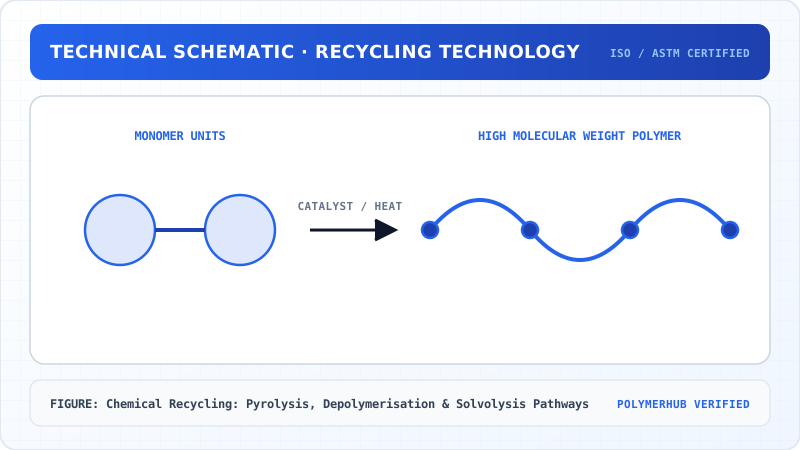
Thermal homolytic cleavage of initiator followed by monomer radical addition.
Rapid successive head-to-tail monomer addition to propagating macroradicals.
Bimolecular mutual radical annihilation via combination or disproportionation.
3.1 Chemical Recycling Pathways
- Thermal Pyrolysis: Heating mixed polyolefin waste (PE, PP) to C in the absence of oxygen to break C–C bonds, producing liquid pyrolysis oil (crude naphtha analogue), hydrocarbon gases, and carbon char. The oil is co-fed into steam crackers.
- Solvolysis: Using solvents and catalysts to cleave ester or amide bonds in condensation polymers (PET, Nylon, Polyurethane):
- Glycolysis: Reacting PET with Ethylene Glycol (EG) to yield BHET monomer.
- Methanolysis: Reacting PET with methanol to yield Dimethyl Terephthalate (DMT) and EG.
- Depolymerisation: Thermally or catalytically unzipping polymers back to monomers (e.g., PMMA to MMA).
3.2 PET Glycolysis Reaction
The glycolysis of PET is a transesterification reaction catalyzed by metal acetates or ionic liquids:
The BHET monomer is purified and repolymerized to food-grade PET.
4. Worked Example
Chemical Recycling: Pyrolysis, Depolymerisation & Solvolysis Pathways — Industrial Process Flow Diagram (PFD)
ISO 10628 Unit Operations & Thermodynamic Control Sequence
Raw Material Feed & Metering
Drying to < 0.02% moisture and gravimetric dosing
Reaction & Polymer Melt Processing
Controlled thermal shear dissipation and phase transition
Shaping & Solidification
Die extrusion or mold cavity pressure packing
Quality Inspection & Testing
ASTM D638 / ISO 527 tensile & MFI compliance check
Problem Statement:
Problem: A chemical recycling plant depolymerises post-consumer PET flakes via glycolysis. The feed is metric tonnes (MT) of PET flakes (monomer molecular weight equivalent g/mol). The reactor uses excess Ethylene Glycol and a zinc acetate catalyst. The reaction yields MT of purified BHET monomer ( g/mol). Calculate:
- The theoretical yield of BHET monomer (in MT) from 5.0 MT of PET.
- The chemical conversion yield (%) of the glycolysis reactor.
Solution Step:
Solution:
- Calculate the theoretical yield of BHET monomer: One mole of PET repeating unit ( g/mol) reacts with one mole of EG to yield one mole of BHET ( g/mol):
- Calculate the chemical conversion yield (%):
Interpretation: The glycolysis reactor achieves an 83.17% chemical conversion yield, producing 5.50 MT of purified BHET monomer. The remaining fraction consists of unreacted oligomers and process losses, which are separated and recycled back to the reactor.
5. Indian Industry Context
Chemical Recycling: Pyrolysis, Depolymerisation & Solvolysis Pathways — CAD Tooling & Machine Geometry Blueprint
Critical Geometric Dimensions & Tolerances (GD&T)
- Primary Processing Tolerance:± 0.02 mm (ISO 20457 Class M1)
- Thermal Expansion Allowance:1.5% (Volumetric Shrinkage)
- Draft Angle Minimum:1.0° - 1.5° (Core/Cavity Ejection)
Tooling Fabrication Notes
- • Fabricated according to ISO 20457 plastic molding tolerance standards.
- • EDM finish SPI C-1 applied across cavity optical contact faces.
- • Conformal cooling lines pressure tested at 12 bar water flow.
Indian polyester manufacturers (such as Reliance Industries and recycling ventures) run chemical recycling setups. They depolymerise waste PET bottles and spinning waste back into DMT/TPA and EG, repolymerizing them into circular polyester yarns.
6. Key Takeaways & Glossary
- Pyrolysis: Anaerobic thermal cracking of polyolefins into liquid fuels and feedstocks.
- Glycolysis: Chemical recycling of PET using ethylene glycol to yield BHET monomer.
- BHET: Bis(2-hydroxyethyl) terephthalate; the monomer intermediate produced by PET glycolysis.
- Solvolysis: Solvent-assisted depolymerisation of condensation polymers.
- ISCC PLUS: International certification verifying mass balance claims for chemically recycled polymers.
7. Standards Reference
- ISCC PLUS — International Sustainability and Carbon Certification guidelines for circular feedstocks
- ASTM D8058 — Standard test methods for evaluating chemical recycling pyrolysis oils
8. Practice Questions
- Write the balanced transesterification reaction of PET methanolysis, displaying the inputs, catalyst, and outputs.
- Contrast thermal pyrolysis with catalytic pyrolysis of mixed PE/PP waste. Focus on processing temperatures and product selectivity.
- Design a process separation schematic to purify BHET monomer from a glycolysis reactor, removing unreacted glycol, catalyst residues, and colorants.
Chemical Recycling: Pyrolysis, Depolymerisation & Solvolysis Pathways · Engineering Triad
Material Synthesis · Processing Hardware · Commercial Application
Standard Engineering Thermoplastic Resin
—[Monomer Backbone]ₙ— (Calibrated Molecular Weight & PDI)
Industrial Polymer Processing & Tooling System
Computer-Controlled Extrusion / Injection Moulding Hardware
Commercial Engineering Parts & Quality-Inspected Components
Automotive, Electrical, Medical & Packaging Applications
Test Your Conceptual Understanding
In polymer science and processing thermodynamics, which factor most directly controls the critical transition temperature?
- Always evaluate molecular weight distribution (MWD) alongside zero-shear viscosity when calculating mold shear rates.
- Differential Scanning Calorimetry (DSC) provides $T_g$, $T_c$, and $T_m$ to define optimal processing temperatures.
- Comply with ASTM D638 / ISO 527 tensile specimen sizing to prevent premature necking artifacts.
Personal Lesson Notes
Please sign in to write and save notes during lessons