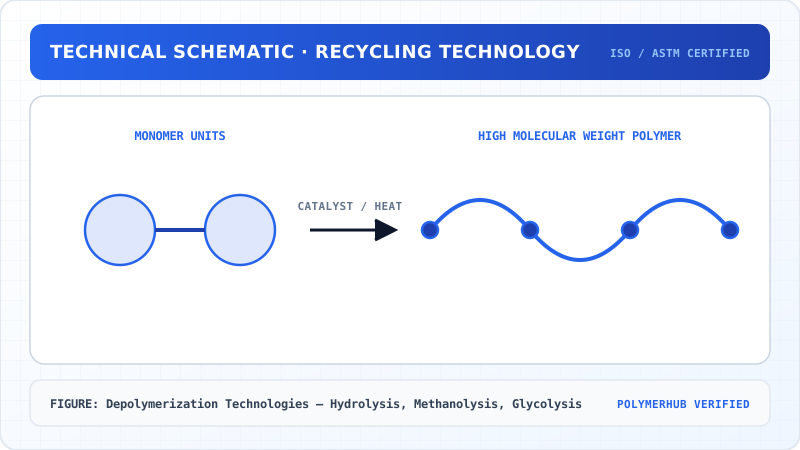
Depolymerization Technologies — Hydrolysis, Methanolysis, Glycolysis
Solvolysis pathways for PET, polyamides, and polyurethanes, catalyst systems, monomer purification, and thermodynamic mass balances.
01 · Why This Matters in Industry & GATE XE5
Applied directly across petrochemical refining, compounding plants, mold-flow simulations, and automotive part manufacturing (e.g., Reliance Industries, Supreme Petrochem, IOCL, CIPET testing protocols).
Molecular Mechanism: Master conformational physics, transition temperatures, and reaction kinetics.
Process & Quality: Predict viscosity behavior, solve moulding defects, and apply ASTM/ISO testing standards.
Depolymerization Technologies — Hydrolysis, Methanolysis, Glycolysis
1. Why This Topic Matters
The burgeoning global challenge of plastic waste demands innovative and sustainable solutions beyond traditional mechanical recycling. As future polymer engineers and technologists, understanding depolymerization technologies is paramount for several critical reasons:
- Real-World Relevance (Circular Economy & Sustainability): Linear "take-make-dispose" models for plastics are unsustainable. Depolymerization, a form of chemical recycling, enables the recovery of high-purity monomers from waste polymers, allowing them to re-enter the production cycle as virgin-equivalent feedstock. This closes the loop, significantly reducing reliance on fossil resources, mitigating plastic pollution, and decreasing greenhouse gas emissions associated with virgin polymer production. It is a cornerstone of the circular economy for plastics.
- Career Relevance: Expertise in chemical recycling opens diverse career pathways in R&D, process engineering, plant operations, material science, and sustainability consulting within the petrochemical, polymer manufacturing, and waste management sectors. India, with its rapidly growing economy and increasing plastic consumption, is investing heavily in sustainable waste management, creating significant demand for professionals skilled in these advanced recycling techniques.
- Specific Engineering Significance: Depolymerization involves complex chemical reaction engineering, process design, and separation science. Engineers must design reactors for multi-phase reactions under harsh conditions (high temperature, pressure, corrosive media), optimize catalyst systems for selectivity and efficiency, and develop sophisticated purification trains to achieve monomer purity acceptable for repolymerization. This field presents formidable challenges in energy integration, heat transfer, and thermodynamic optimization, pushing the boundaries of chemical process engineering. Moreover, it necessitates a deep understanding of polymer chemistry, kinetics, and material properties to effectively transform waste back into valuable chemical building blocks.
2. Learning Objectives
Upon completion of this lesson, students will be able to:
- Analyze and differentiate the chemical reaction mechanisms, kinetics, and typical operating conditions for hydrolysis, methanolysis, and glycolysis across various condensation polymers such as PET, polyamides, and polyurethanes.
- Evaluate and select appropriate catalyst systems (acidic, basic, Lewis acid) and process parameters for maximizing monomer yield and purity in specific depolymerization processes, considering economic and environmental factors.
- Design and optimize a conceptual process flow for monomer recovery and purification post-depolymerization, including thermodynamic mass balances, to produce virgin-quality monomers from post-consumer or post-industrial polymer waste.
3. Core Theory & Mathematical Principles
Thermal homolytic cleavage of initiator followed by monomer radical addition.
Rapid successive head-to-tail monomer addition to propagating macroradicals.
Bimolecular mutual radical annihilation via combination or disproportionation.
Depolymerization, specifically solvolysis, involves the chemical breakdown of polymers into their constituent monomers or oligomers using a solvent that also acts as a reactant. This process targets specific susceptible linkages in the polymer backbone, such as ester, amide, or urethane bonds.
3.1 General Solvolysis Reaction
For a condensation polymer, the general solvolysis reaction can be represented as:
Here, represents the degree of polymerization or the number of repeating units.
3.2 Hydrolysis
Hydrolysis involves the scission of polymer chains by water. It is particularly effective for polymers with ester or amide linkages.
3.2.1 Hydrolysis of Polyethylene Terephthalate (PET)
PET is a polyester formed from terephthalic acid (TPA) and ethylene glycol (EG). Hydrolysis breaks the ester linkages:
Catalysts: Strong acids (e.g., ) or bases (e.g., ) are used. Conditions: Typically high temperatures () and pressures () are required for efficient hydrolysis, often in a batch or continuous stirred tank reactor (CSTR). Kinetics: The rate of hydrolysis () can be approximated as a pseudo-first-order reaction with respect to the ester bond concentration () in the presence of excess water and catalyst:
where is the pseudo-first-order rate constant, which is temperature-dependent following the Arrhenius equation:
Here, is the pre-exponential factor, is the activation energy, is the ideal gas constant, and is the absolute temperature.
3.2.2 Hydrolysis of Polyamides (e.g., Nylon 6, Nylon 6,6)
Polyamides are susceptible to hydrolysis of their amide linkages.
For Nylon 6,6, the products are hexamethylenediamine and adipic acid. Catalysts: Concentrated acids (e.g., ) or bases (e.g., ) are generally required. Conditions: Elevated temperatures () and often high pressures.
3.3 Methanolysis (Alcoholysis)
Methanolysis is a transesterification reaction where methanol acts as the solvolytic agent, breaking ester linkages and forming methyl esters. It is particularly effective for PET.
3.3.1 Methanolysis of PET
Methanol reacts with the ester bonds of PET, producing dimethyl terephthalate (DMT) and ethylene glycol (EG).
Catalysts: Typically metal acetates (e.g., , ) or metal alkoxides. Lewis acids are also effective. Conditions: Lower temperatures () and pressures () compared to hydrolysis. Supercritical methanol conditions (, ) can significantly accelerate the reaction without a catalyst, offering higher purity. Advantages: DMT is easier to purify via distillation than TPA from hydrolysis, and it can be directly repolymerized.
3.4 Glycolysis (Alcoholysis)
Glycolysis involves the transesterification of a polymer with a glycol (e.g., ethylene glycol). For PET, this typically yields bis(hydroxyethyl) terephthalate (BHET) and its oligomers.
3.4.1 Glycolysis of PET
The reaction of PET with excess ethylene glycol yields BHET, which is a key intermediate for PET synthesis.
Catalysts: Metal acetates (e.g., , ) are common. Conditions: Moderate temperatures () at atmospheric or slightly elevated pressure. Applications: Glycolysis is often used for partial depolymerization to produce oligomers that can be directly incorporated into new PET manufacturing, rather than full monomer recovery. It is also a preferred method for producing recycled PET (rPET) resins.
3.4.2 Glycolysis of Polyurethanes (PU)
Polyurethanes, formed from polyols and isocyanates, contain urethane () and urea () linkages. Glycolysis breaks these linkages using excess glycol, regenerating polyols and amines.
Catalysts: Organometallic catalysts (e.g., dibutyltin dilaurate, metal acetates) or amines. Conditions: . The reaction can be complex due to the variety of linkages and potential for side reactions. Products: The recovered polyols can be directly used in the synthesis of new polyurethanes, albeit with potentially altered properties depending on purification.
3.5 Monomer Purification
Post-depolymerization, the crude product mixture often contains unreacted polymer, catalysts, side products, and impurities (e.g., dyes, additives, other plastics). Purification is critical to obtain virgin-quality monomers.
- Crystallization: For solid monomers like TPA or DMT, fractional crystallization is commonly employed based on solubility differences.
- Distillation: For volatile monomers like EG or DMT (if pure enough), fractional distillation can separate components based on boiling points.
- Solvent Extraction: Used to selectively dissolve and separate desired monomers from impurities.
- Activated Carbon Treatment: Removes colorants and other dissolved impurities.
- Filtration: To remove solid impurities and unreacted polymer.
3.6 Thermodynamic Mass Balances
A thorough mass balance is crucial for process design, economic evaluation, and yield optimization. For a continuous process at steady state, the total mass entering a system equals the total mass exiting the system:
Where and are the mass flow rates of input and output streams, respectively.
For a batch process:
The conversion of polymer () is defined as:
The yield of a specific monomer () is calculated based on the theoretical maximum production from the consumed polymer:
Alternatively, based on the initial polymer:
Careful consideration of stoichiometry is vital. For example, in PET hydrolysis, 1 mole of PET repeating unit yields 1 mole of TPA and 1 mole of EG.
4. Worked Numerical Example
Depolymerization Technologies — Hydrolysis, Methanolysis, Glycolysis — Industrial Process Flow Diagram (PFD)
ISO 10628 Unit Operations & Thermodynamic Control Sequence
Raw Material Feed & Metering
Drying to < 0.02% moisture and gravimetric dosing
Reaction & Polymer Melt Processing
Controlled thermal shear dissipation and phase transition
Shaping & Solidification
Die extrusion or mold cavity pressure packing
Quality Inspection & Testing
ASTM D638 / ISO 527 tensile & MFI compliance check
Problem Statement: A batch reactor is used for the methanolysis of 1000 kg of post-consumer PET waste. The reaction proceeds at and 20 bar. An excess of methanol (1.5 times the stoichiometric requirement) is used to drive the reaction towards completion. The overall conversion of PET is 95%, and the yield of Dimethyl Terephthalate (DMT) based on the converted PET is 90%. Assume the PET waste is 98% pure PET by mass, with the remaining 2% being inert impurities. Calculate the mass of DMT and Ethylene Glycol (EG) produced, and the mass of unreacted PET.
Solution Step:
Solution:
Step 1: Determine molar masses of reactants and products.
- Repeating unit of PET:
- Molar mass of PET repeating unit ():
- Methanol ():
- Molar mass ():
- Dimethyl Terephthalate (DMT, ):
- Molar mass ():
- Ethylene Glycol (EG, ):
- Molar mass ():
Step 2: Write the balanced chemical reaction for methanolysis of PET. The reaction for one repeating unit of PET:
From this stoichiometry, 1 mole of PET repeating unit reacts with 2 moles of methanol to produce 1 mole of DMT and 1 mole of EG.
Step 3: Calculate the initial mass and moles of pure PET.
- Total PET waste: 1000 kg
- Purity of PET: 98%
- Mass of pure PET ():
- Initial moles of pure PET ():
Step 4: Calculate the moles of PET converted.
- Conversion of PET (): 95%
- Moles of PET converted ():
Step 5: Calculate the theoretical moles of DMT and EG produced from converted PET. From stoichiometry, 1 mole PET 1 mole DMT + 1 mole EG.
- Theoretical moles of DMT ():
- Theoretical moles of EG ():
Step 6: Calculate the actual mass of DMT produced.
- Yield of DMT (): 90% (based on converted PET)
- Actual moles of DMT ():
- Mass of DMT produced ():
Step 7: Calculate the actual mass of EG produced. Assuming the yield of EG is also 90% (often a reasonable assumption if DMT is the main desired product and side reactions are minimal or accounted for in the overall yield).
- Actual moles of EG ():
- Mass of EG produced ():
Step 8: Calculate the mass of unreacted PET.
- Moles of unreacted PET ():
- Mass of unreacted PET ():
Summary of Results:
- Mass of Dimethyl Terephthalate (DMT) produced: 846.67 kg
- Mass of Ethylene Glycol (EG) produced: 270.69 kg
- Mass of unreacted PET: 49.00 kg
(Note: The methanol calculation was not required for the specific questions asked, but in a full mass balance, it would be included, accounting for the excess and any unreacted methanol.)
5. Indian Industrial Context
Depolymerization Technologies — Hydrolysis, Methanolysis, Glycolysis — CAD Tooling & Machine Geometry Blueprint
Critical Geometric Dimensions & Tolerances (GD&T)
- Primary Processing Tolerance:± 0.02 mm (ISO 20457 Class M1)
- Thermal Expansion Allowance:1.5% (Volumetric Shrinkage)
- Draft Angle Minimum:1.0° - 1.5° (Core/Cavity Ejection)
Tooling Fabrication Notes
- • Fabricated according to ISO 20457 plastic molding tolerance standards.
- • EDM finish SPI C-1 applied across cavity optical contact faces.
- • Conformal cooling lines pressure tested at 12 bar water flow.
India, being one of the largest plastic consumers and waste generators globally, presents a unique and critical landscape for depolymerization technologies. The drive towards a circular economy for plastics is gaining momentum, fueled by government regulations, corporate sustainability goals, and increasing environmental awareness.
- Reliance Industries Ltd. (RIL): As a global leader in polyester production, RIL has significant interest and capabilities in PET recycling. While primarily focused on mechanical recycling (producing rPET flakes and fibers), their petrochemical expertise positions them strongly to explore advanced chemical recycling routes like depolymerization, potentially integrating it into their massive PET production value chain for virgin-quality monomer recovery. Their scale and backward integration capabilities could make such ventures highly impactful.
- Central Institute of Petrochemicals Engineering & Technology (CIPET): CIPET, with its network of institutes across India, plays a crucial role in skill development, R&D, and technical support for the plastics industry. They are actively involved in research on plastic waste management, including chemical recycling processes. Their laboratories could serve as incubators for depolymerization technology validation and optimization relevant to Indian waste streams.
- Emerging Chemical Recyclers & Startups: While the large-scale industrial implementation of depolymerization is nascent in India, several startups and smaller enterprises are exploring chemical recycling solutions. These entities often target mixed plastic waste or difficult-to-recycle plastics, seeking to convert them into pyrolysis oils or other chemical feedstocks, which are precursors to monomers. As technologies mature and economics improve, more focused depolymerization plants for specific polymers like PET or polyurethanes are expected to emerge.
- Plastic Waste Management Rules & EPR: The Indian government's Plastic Waste Management Rules, 2016 (and subsequent amendments), including the Extended Producer Responsibility (EPR) guidelines, are a major driver for increased recycling efforts. Brands and producers are mandated to collect and recycle a certain percentage of their plastic packaging, which will likely encourage investment in both mechanical and chemical recycling infrastructure. This creates a market pull for high-quality recycled content that depolymerization can reliably deliver.
- Challenges and Opportunities: India's informal recycling sector handles a significant portion of plastic waste. Integrating advanced depolymerization technologies into this existing ecosystem, ensuring a consistent and segregated feedstock supply, and addressing the logistics of waste collection remain significant challenges. However, the abundance of plastic waste, particularly PET bottles, provides a substantial feedstock opportunity for large-scale depolymerization plants. Furthermore, the ability to recycle textile waste (polyester fibers) is a high-value opportunity for India's textile industry.
6. Standard Operating Procedures & Standards
The successful implementation and commercialization of depolymerization technologies rely heavily on adherence to robust standards for feedstock characterization, process control, and product quality.
- Feedstock Characterization (Waste Plastics):
- BIS IS 14535: Specification for Polyethylene Terephthalate (PET) Bottles. This standard is crucial for assessing the quality and composition of incoming PET waste, including purity, color, and contaminant levels, which directly impact depolymerization efficiency and monomer purity.
- ASTM D1929 / ISO 1183: Methods for determining the density of plastics by displacement, useful for quick identification of mixed plastic waste.
- ASTM D5033 / ISO 11357: Differential Scanning Calorimetry (DSC) for thermal analysis of plastics, to identify polymer types and melt behavior.
- FTIR Spectroscopy (ASTM E1252): Used for rapid identification of polymer types in mixed waste streams.
- Process Monitoring and Control:
- Temperature and Pressure Control: Adherence to established standards for process control and instrumentation (e.g., ISA 5.1-2007 on Instrumentation Symbols and Identification) is critical for maintaining optimal reaction conditions and safety.
- Catalyst Concentration and Activity: In-process analytical techniques to monitor catalyst performance and prevent catalyst poisoning.
- Product Characterization (Monomers/Oligomers):
- ASTM D4603 / ISO 16773: Determining inherent viscosity of PET (can be adapted for oligomer characterization if they are polymerized back to PET).
- Gas Chromatography (GC) / High-Performance Liquid Chromatography (HPLC): For quantitative analysis of monomer purity, identification of by-products, and unreacted reactants (e.g., ASTM D4421 for analysis of EG by GC).
- Titration Methods: For determining acid number, hydroxyl number, or amine number of recovered products, especially relevant for polyols from polyurethane glycolysis.
- Color and Clarity Standards: (e.g., ASTM D1003 for haze and luminous transmittance of transparent plastics) to ensure virgin-like quality of recovered monomers for subsequent polymerization.
- Safety Standards:
- OSHA / Factories Act (India): Regulations pertaining to handling hazardous chemicals (e.g., methanol, acids, bases), high-temperature and high-pressure operations, and general industrial safety.
- NFPA 704: Standard system for the identification of hazards of materials for emergency response (for chemical storage).
- Environmental Standards:
- BIS 17088 / ISO 14021: Environmental labels and declarations – Self-declared environmental claims (Type II environmental labelling) – including definitions for terms like "recycled content."
7. Key Takeaways & Glossary
Key Takeaways
- High-Value Recycling Pathway: Depolymerization technologies like hydrolysis, methanolysis, and glycolysis offer a superior chemical recycling route compared to mechanical recycling, enabling the recovery of high-purity, virgin-equivalent monomers or oligomers suitable for repolymerization into high-performance materials.
- Polymer-Specific Optimization: The choice of depolymerization technology (solvolytic agent), catalyst system (acidic, basic, Lewis acid), and reaction conditions (temperature, pressure, time) must be carefully optimized for specific polymer types (PET, polyamides, polyurethanes) to achieve maximum conversion, yield, and selectivity for desired products.
- Critical Role of Purification & Mass Balance: The economic viability and environmental benefits of depolymerization processes are critically dependent on efficient monomer purification techniques to remove impurities and accurate thermodynamic mass balances for process design, material accounting, and overall resource efficiency.
Glossary
- Solvolysis: A chemical reaction in which a solvent (such as water, methanol, or ethylene glycol) acts as a reactant to break one or more chemical bonds in a solute molecule, typically leading to the formation of smaller molecules.
- Transesterification: A chemical reaction where an ester is transformed into a different ester by reacting it with an alcohol or another ester, often catalyzed by acids or bases. It is the underlying mechanism for methanolysis and glycolysis of polyesters.
- Bis(hydroxyethyl) terephthalate (BHET): The primary monomeric product obtained from the glycolysis of PET. It is a key intermediate in the synthesis of new PET, possessing two hydroxyl end groups for further polymerization reactions.
8. Exam & Interview Practice Questions
GATE-style Multiple Choice Question
Question: Which of the following is the primary monomeric product obtained from the complete methanolysis of Polyethylene Terephthalate (PET)?
(A) Terephthalic Acid (TPA) (B) Dimethyl Terephthalate (DMT) (C) Bis(hydroxyethyl) terephthalate (BHET) (D) Ethylene Glycol (EG)
Correct Answer: (B)
Explanation: Methanolysis is a transesterification reaction where methanol replaces the ethylene glycol units in the PET backbone. This results in the formation of methyl ester end groups, yielding Dimethyl Terephthalate (DMT) and Ethylene Glycol (EG). Terephthalic Acid (TPA) is the product of hydrolysis, and Bis(hydroxyethyl) terephthalate (BHET) is the product of glycolysis. Ethylene Glycol (EG) is a co-product, not the primary terephthalate-based monomer.
Numerical Question
Question: A chemical recycling plant processes 500 kg/hour of waste Nylon 6,6 via hydrolysis. The Nylon 6,6 feedstock is 90% pure polymer, and the remaining 10% is inert material. The hydrolysis reaction achieves 92% conversion of the pure Nylon 6,6. Assuming an 85% yield of both hexamethylenediamine (HMDA) and adipic acid (AA) based on the converted polymer, calculate the mass flow rates (in kg/hour) of HMDA and AA produced.
Solution Step:
Solution:
Step 1: Determine molar masses.
- Repeating unit of Nylon 6,6: (from hexamethylenediamine and adipic acid condensation minus 2 water molecules)
- Molar mass of Nylon 6,6 repeating unit ():
- Hexamethylenediamine (HMDA, ):
- Molar mass ():
- Adipic Acid (AA, ):
- Molar mass ():
Step 2: Write the balanced chemical reaction for hydrolysis of Nylon 6,6. The reaction for one repeating unit of Nylon 6,6:
From this stoichiometry, 1 mole of Nylon 6,6 repeating unit reacts with 2 moles of water to produce 1 mole of HMDA and 1 mole of AA.
Step 3: Calculate the mass flow rate and moles of pure Nylon 6,6 input.
- Total waste input: 500 kg/hour
- Purity of Nylon 6,6: 90%
- Mass flow rate of pure Nylon 6,6 ():
- Initial molar flow rate of pure Nylon 6,6 ():
Step 4: Calculate the moles of Nylon 6,6 converted.
- Conversion of Nylon 6,6 (): 92%
- Molar flow rate of Nylon 6,6 converted ():
Step 5: Calculate the theoretical moles of HMDA and AA produced from converted Nylon 6,6. From stoichiometry, 1 mole N66 1 mole HMDA + 1 mole AA.
- Theoretical molar flow rate of HMDA ():
- Theoretical molar flow rate of AA ():
Step 6: Calculate the actual mass flow rate of HMDA produced.
- Yield of HMDA (): 85%
- Actual molar flow rate of HMDA ():
- Mass flow rate of HMDA produced ():
Step 7: Calculate the actual mass flow rate of AA produced.
- Yield of AA (): 85%
- Actual molar flow rate of AA ():
- Mass flow rate of AA produced ():
Summary of Results:
- Mass flow rate of Hexamethylenediamine (HMDA) produced: 180.80 kg/hour
- Mass flow rate of Adipic Acid (AA) produced: 227.23 kg/hour
Conceptual University Exam Question
Question: Discuss the relative advantages and disadvantages of hydrolysis, methanolysis, and glycolysis as chemical recycling routes for post-consumer PET. Consider aspects such as reaction conditions, product purity, ease of monomer purification, and applicability in the context of India's plastic waste management challenges.
Answer:
Chemical recycling of PET via solvolysis methods — hydrolysis, methanolysis, and glycolysis — each offers distinct advantages and disadvantages, making their selection dependent on specific objectives, feedstock quality, and desired output.
1. Hydrolysis of PET:
- Advantages:
- Simple Reagent: Water is a cheap, abundant, and environmentally benign reagent.
- Direct TPA Production: Produces terephthalic acid (TPA), which is a direct monomer for PET synthesis, requiring minimal further chemical modification if purified.
- Environmental Profile: Avoids organic solvents in the depolymerization step, reducing solvent recovery and disposal issues.
- Disadvantages:
- Harsh Conditions: Requires very high temperatures () and pressures () to achieve reasonable reaction rates, leading to higher energy consumption and more demanding reactor design.
- Corrosion: Strong acid or base catalysts can cause significant corrosion of equipment, necessitating expensive, corrosion-resistant materials.
- TPA Purification Challenges: TPA is a solid and can be difficult to purify from colored impurities, dyes, and other plastic contaminants (e.g., PVC fragments) via crystallization, potentially limiting its use in virgin-grade PET.
- Indian Context: The abundant availability of water is an advantage. However, the high capital cost for high-pressure/temperature reactors and challenges in purifying TPA from mixed Indian waste streams (often containing diverse contaminants) could be significant hurdles.
2. Methanolysis of PET:
- Advantages:
- Lower Conditions: Generally operates at milder temperatures () and pressures () compared to hydrolysis, potentially leading to lower CAPEX and OPEX.
- Easier Monomer Purification: Produces Dimethyl Terephthalate (DMT), which is a liquid at its reaction temperature and can be readily purified by distillation due to its volatility and crystallinity, yielding high-purity product.
- Proven Technology: DMT-based PET production was historically common, so the subsequent polymerization infrastructure is well-understood.
- Disadvantages:
- Methanol Handling: Requires handling and recovery of methanol, a flammable and toxic solvent, which adds to safety and environmental considerations.
- Catalyst Management: Requires specific transesterification catalysts (e.g., metal acetates), which need to be separated and managed.
- DMT-to-TPA Conversion: If the target is TPA-based PET, DMT needs to be hydrolyzed back to TPA, adding an extra step.
- Indian Context: The relative ease of purification of DMT makes it attractive for producing high-quality monomers from potentially varied waste streams. However, ensuring a steady, affordable supply of high-purity methanol and managing its hazardous nature will be crucial.
3. Glycolysis of PET:
- Advantages:
- Mildest Conditions: Operates at relatively mild conditions () and often at atmospheric or slightly elevated pressure, reducing energy costs and equipment requirements.
- Direct Oligomer (BHET) Production: Produces bis(hydroxyethyl) terephthalate (BHET) or its oligomers, which can be directly fed back into a conventional PET polymerization plant, integrating well with existing infrastructure.
- Partial Depolymerization: Often used for partial depolymerization, making it suitable for producing recycled content with specific molecular weights for various applications.
- Disadvantages:
- Product Purity: The product is often a mixture of BHET and various oligomers, making full monomer purification more complex than DMT. It may also lead to undesirable side reactions (e.g., diethylene glycol formation).
- Recycling Loop: The recovered BHET is often used for producing rPET, not necessarily virgin-equivalent monomers for full circularity, unless extensively purified.
- Color Reversion: Can be prone to color reversion issues if not carefully managed, especially with contaminated feedstock.
- Indian Context: Glycolysis, particularly for producing rPET grades, is likely to find a strong niche in India due to its milder conditions and the ability to integrate into existing PET manufacturing facilities. It offers a practical solution for processing large volumes of PET bottle waste for specific rPET applications, aligning with the "make in India" initiative for sustainable plastics.
Conclusion for Indian Context: In India, the choice among these technologies would depend on factors like the availability and quality of feedstock, capital investment capacity, infrastructure for chemical handling, and the target market for the recovered monomers/oligomers. Given the challenges of mixed plastic waste and the need for cost-effective solutions, glycolysis might be more immediately adoptable for producing rPET. However, for achieving true circularity and producing virgin-equivalent monomers from diverse and contaminated waste streams, methanolysis (for its ease of purification) or advanced hydrolysis (if economic and corrosion challenges are addressed) represent more comprehensive long-term solutions. Developing robust purification technologies suitable for the diverse and often challenging Indian plastic waste streams is critical for the success of any depolymerization approach.
Depolymerization Technologies — Hydrolysis, Methanolysis, Glycolysis · Engineering Triad
Material Synthesis · Processing Hardware · Commercial Application
Standard Engineering Thermoplastic Resin
—[Monomer Backbone]ₙ— (Calibrated Molecular Weight & PDI)
Industrial Polymer Processing & Tooling System
Computer-Controlled Extrusion / Injection Moulding Hardware
Commercial Engineering Parts & Quality-Inspected Components
Automotive, Electrical, Medical & Packaging Applications
Test Your Conceptual Understanding
In polymer science and processing thermodynamics, which factor most directly controls the critical transition temperature?
- Always evaluate molecular weight distribution (MWD) alongside zero-shear viscosity when calculating mold shear rates.
- Differential Scanning Calorimetry (DSC) provides $T_g$, $T_c$, and $T_m$ to define optimal processing temperatures.
- Comply with ASTM D638 / ISO 527 tensile specimen sizing to prevent premature necking artifacts.
Personal Lesson Notes
Please sign in to write and save notes during lessons